

The key to their success wasn’t just talent. It was hard work, willingness to change and collaborate with others, and the determination to keep going even when things seemed hopeless.
Imagine being one of the biggest rock bands in America, selling millions of albums, and then losing it all. That’s precisely what happened to Aerosmith in the late 1970s and early 1980s.
By 1980, Aerosmith was falling apart. Lead singer Steven Tyler and guitarist Joe Perry were both heavily addicted to heroin, cocaine, and alcohol. Their drug problems got so bad that Tyler once faked passing out on stage because he was too drunk to perform. He literally threw himself on the floor and pretended to have a seizure to avoid singing.
Things weren’t any better for Joe Perry. Even though he had left Aerosmith to start his own band (the Joe Perry Project), he was still struggling. He described himself as “a barely functioning drunk addicted to snorting heroin.” His marriage was falling apart, and he owed $180,000 in hotel room service charges alone. He was getting threats from drug dealers he owed money to, and the IRS was trying to take his house.
The other band members weren’t doing much better. Bassist Tom Hamilton had to sell his house. Drummer Joey Kramer spent all his savings until he had “nothing.” Guitarist Brad Whitford sold his guitars and his home before finally quitting the band in frustration. By 1983, Steven Tyler admitted he had “blown $20 million” on drugs.

Rock Bottom Gets Even Deeper
The band’s problems weren’t just about money and drugs. Their personal lives were a mess, too. Tyler’s fights with his wife became violent, fueled by what he called “cocaine insanity.” Once, he jumped on her car and smashed the windshield during an argument. Perry’s marriage also collapsed, and he faced a brutal legal battle to see his young son.
Professionally, things were just as bad. When Perry left in 1979, Aerosmith’s concert attendance dropped by 80% in just six months. They went from playing huge stadiums and earning hundreds of thousands of dollars to playing in small clubs for as little as $2,000 a night by 1984.
Their reputation was so damaged that promoters stopped trusting them and often asked for large deposits before booking them.
Even when the band released new music, it flopped. Their 1982 album “Rock in a Hard Place” only went Gold (not platinum like their earlier hits), and Tyler later admitted that the tour was “a disaster.”
The First Steps Back: Reunion and Reality
Despite everything, Tyler and Perry stayed in touch. In 1983, Tyler went to see Perry’s band perform, and Perry came to an Aerosmith concert. Backstage, they did heroin together “just for old times’ sake.” That night, Tyler collapsed on stage in front of 14,000 people.
But something was changing. Tyler was living in a hotel on $20 a day, and Perry was taking any gig he could get, traveling in vans and staying in cheap hotels. Both realized they missed working together.
In early 1984, the original five members met at Tom Hamilton’s house (he was the only one who still had a home).
They decided to reunite, but only if they could work with Perry’s new manager, Tim Collins. Collins was different from their old managers; he genuinely cared about the band and even helped Perry pay off some debts to earn his trust.
The reunited Aerosmith went on the “Back in the Saddle” tour in 1984, playing small clubs. Some shows were good, some were terrible, but fans were excited to see the original lineup back together. Even though they were still using drugs, they managed to make $3 million from club shows that year, proving they could still perform.
The Turning Point: Getting Clean
Tyler tried to rehab several times between 1983 and 1986, but it never stuck. The problem was that while Tyler was trying to get sober, the rest of the band kept getting high. Tyler would rebel and start using drugs again.
Everything changed in the fall of 1986. Tim Collins hired a therapist to stage what’s called an “intervention”, when friends and family confront someone about their addiction.
This time, Tyler was furious at being singled out, but the pressure from everyone around him worked. He entered rehab and came out determined to make the rest of the band get clean, too.
One by one, starting with Joe Perry in October 1986, all five members went through rehab. For the first time in over a decade, Aerosmith was completely sober. This was the real turning point. Healthy and focused, they could finally work together properly again.
The Breakthrough: “Walk This Way” with Run-D.M.C.
While the reunited Aerosmith was finding its footing, something unexpected happened that would change everything. In March 1986, they were asked to work with a hip-hop group called Run-D.M.C. on a new version of their 1975 song “Walk This Way.”
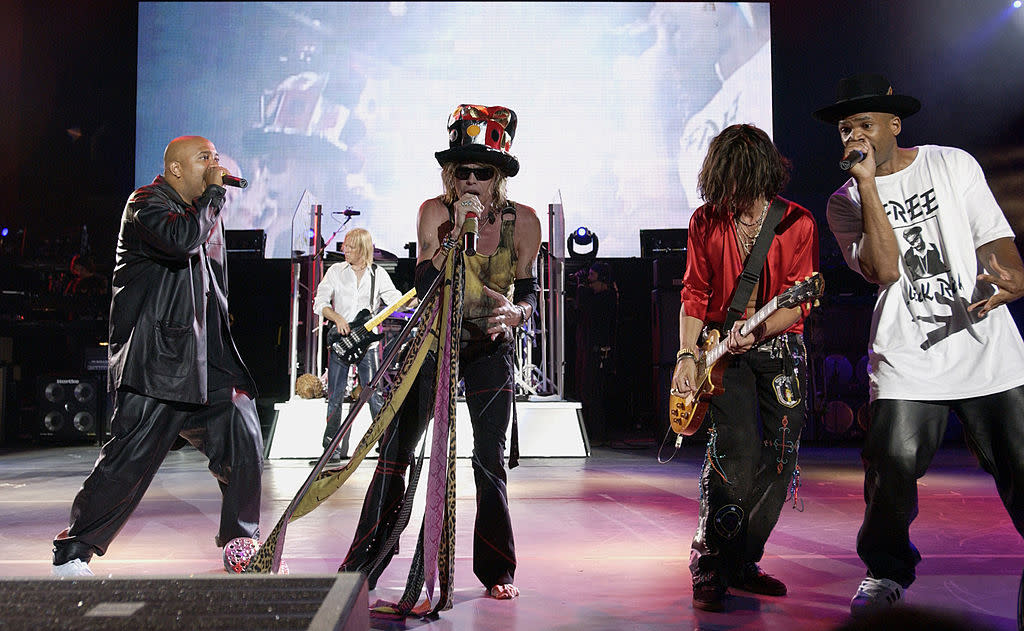
At the time, rock and rap were completely separate worlds. Many people didn’t think the collaboration would work. But when the song came out, it became a massive hit, reaching #4 on the Billboard charts. The music video, which showed the two groups literally breaking down a wall between them, became an MTV sensation.
This collaboration introduced Aerosmith to a whole new generation of fans who had never heard of them. It also helped bring hip-hop into the mainstream and showed that rock and rap could work together. More importantly, it proved that Aerosmith could still be relevant in the 1980s.
The Big Comeback: Working with Outside Writers
Now sober and back in the spotlight, Aerosmith needed to prove they could make great new music. Their record label assigned them an A&R man named John Kalodner, who had a controversial idea: the band should work with professional songwriters from outside the group.
At first, Tyler and Perry were insulted. They’d always written their own songs. But Kalodner convinced them that to get radio hits in the 1980s, they needed fresh ideas. He sent them to Vancouver to work with producer Bruce Fairbairn (who had just made Bon Jovi’s huge album “Slippery When Wet”) and songwriters Jim Vallance and Desmond Child.
Desmond Child was particularly important. He’d written hits for Kiss and Bon Jovi, and he pushed Tyler to try new things. Their collaboration wasn’t always smooth, Tyler said they “always got into arguments”, but it worked. Together, they wrote “Dude (Looks Like a Lady)” and the power ballad “Angel.”
“Permanent Vacation”: The Comeback Album
In August 1987, Aerosmith released “Permanent Vacation.” Tyler called it “the best album we’d made in 10 years, and the first one we ever did sober.”
The album was a huge success. “Dude (Looks Like a Lady)” reached #14 on the charts, but the real monster hit was “Angel,” which climbed all the way to #3, their biggest hit ever at that point. The album went double platinum, and their tour ran from October 1987 to September 1988, taking them back to the same level of success they’d enjoyed in the mid-1970s.
“Pump”: Reaching New Heights
After a short break, Aerosmith went back into the studio in February 1989 to record “Pump.” Released in September 1989, this album took them to even greater success.
“Pump” had six hit singles, including “Love in an Elevator,” “Janie’s Got a Gun” (which dealt with the serious topic of child abuse), and “What It Takes.” The album reached #5 in America and #3 in Britain, and eventually sold over 7 million copies in the U.S. alone.
“Janie’s Got a Gun” won them their first Grammy Award and proved they could tackle serious subjects. The album felt more authentic than “Permanent Vacation”; it featured more complex riffs, funkier rhythms, and showcased more of the band’s creative input.
Joe Perry said, “Pump really felt like that band we had back in the 70s.” The album launched a year-long world tour that finally established Aerosmith as a genuinely global act, not just an American band.
Aerosmith’s comeback is considered one of the greatest in rock history for several reasons:
Against All Odds: The chances of one person overcoming serious addiction are small. What are the chances of five people doing it together and then becoming even more successful than before? Almost impossible. Yet that’s precisely what happened.
Second Chances in Music: In the music business, bands rarely get second chances. Aerosmith proved that with determination, sobriety, and willingness to adapt, a comeback was possible.
Cultural Impact: The “Walk This Way” collaboration helped break down barriers between rock and rap, forever changing popular music. It showed that different styles could work together.
MTV Era Masters: Aerosmith figured out how to use music videos and MTV to reach new audiences without losing what made them special in the first place.
Inspiration for Others: Their public journey from addiction to recovery became a model for other musicians struggling with similar problems. They showed that rock stars could get clean and stay successful.
The Bottom Line
Aerosmith’s story is about falling as far as you can fall, losing money, homes, families, and nearly their lives to addiction, and then climbing all the way back to the top. They went from playing tiny clubs for almost no money to being global superstars, selling millions of albums.
They proved that it’s never too late for a second chance, and that sometimes the comeback can be even bigger than the original success.
By the end of the 1980s, Aerosmith had accomplished something almost unheard of in rock music: they were more popular and successful than they’d been during their 1970s peak.