
From segregated St. Louis to shaping the sound, style, and attitude of modern music
When rock and roll began to take shape in the 1950s, it did not arrive fully formed. It needed structure, a voice, and a way to connect with everyday life. That shape came largely through one man: Chuck Berry.
His story is not just about music. It is about control, survival, race, business, and a constant push to stay ahead in a system that was not built for him.
Growing up in a world with limits
Chuck Berry was born in 1926 in St. Louis, Missouri, in a part of the city where Black families built their own community inside a segregated system. His family lived with discipline, steady routines, and a strong focus on work. His father ran a construction business. His mother was active in the church. Expectations were clear.
From an early age, Berry showed two sides that would follow him his whole life. He had a natural ear for music and performed in school and church. At the same time, he resisted rules and structure. He learned trades like carpentry and photography, but he was not interested in a quiet, predictable life.
That tension led to a turning point.
The mistake that changed everything
At 17, Berry left school and traveled with friends. What followed was not a small mistake. They committed a series of robberies, were arrested, and he was sentenced to time in a reformatory.
Inside, he did not stop performing. He sang, formed a group, and learned discipline in different ways. The experience stayed with him. When he was released at 21, he returned home with a clear understanding of what failure looked like and how quickly things could fall apart.
From that point on, he became more careful about his choices and how he lived.
Starting again, slowly
Back in St. Louis, Berry chose stability first. He worked regular jobs, including factory work and photography, while playing music at night. There was no sudden breakthrough. It was years of balancing work and music, building skill and confidence in local clubs.
During this period, he developed something that set him apart. He did not stay in one style. He blended blues with country phrasing, creating a guitar sound that felt sharper and brighter than traditional rhythm and blues.
That shift became the foundation of his career.
Chicago and the first break
In the early 1950s, Berry traveled to Chicago and met Muddy Waters, who advised him to approach Chess Records. That meeting changed everything.
Berry brought in a version of a country song he had been playing live. It was reworked into “Maybellene” in 1955.
The tempo was fast, and the guitar cut through clearly. The story followed a car chase, told in a direct, modern way. It crossed over from R&B into mainstream charts.
This went beyond a hit and showed where rock and roll was heading.
Building the sound of rock
From that point forward, Berry began shaping a new musical language.
“Roll Over Beethoven” pushed the idea further, calling for a shift away from older musical forms. “Rock and Roll Music” made the case even clearer, turning the genre into something self-aware.
Then came “Johnny B. Goode.”
The opening guitar riff became one of the most recognizable in music. The story followed a young guitarist rising from nothing. It reflected Berry’s own life, but it was written in a way that anyone could follow.
His influence can be heard in the music that came after him. He was not just writing songs for the moment; he was shaping how rock songs would be built in the future.
His approach brought a clear verse-and-chorus pattern that made songs easy to follow without losing energy. The guitar was no longer just part of the background; it carried the track’s identity through short, sharp, repeatable riffs that listeners could recognize instantly.

His lyrics moved away from abstract themes and focused on everyday life, cars, school, relationships, and small moments that felt real and familiar. Even the length of his songs mattered, keeping them tight and direct, usually within a few minutes, so nothing felt stretched or unnecessary.
Over time, this way of writing and structuring songs became the basis on which countless artists worked, whether they were aware of it or not.
The guitar, the stage, and the image
Berry’s guitar style stood out for its precision and memorability. He used double stops, short lead lines, and repeated phrases that listeners could recognize immediately.
At the same time, he understood performance.
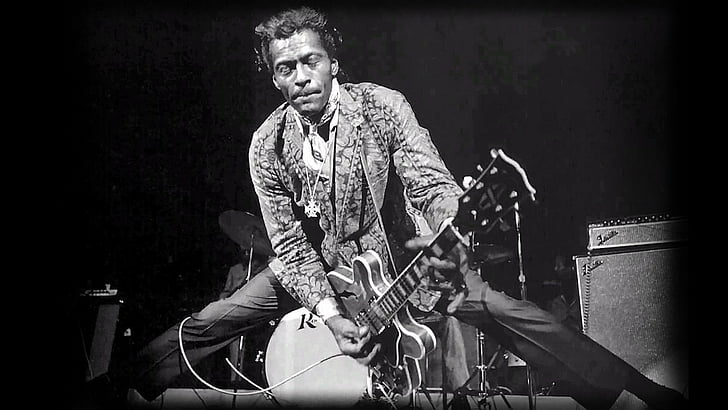
His “duck walk,” a bent-knee movement across the stage while playing, became one of the most recognizable images in rock. It came from a childhood habit, but on stage it turned into something else. It gave the music movement and made the performance both visual and musical.
This combination of sound and presence created a model for future artists.
Partnership behind the scenes
One of the most important parts of his early sound came from his work with Johnnie Johnson.
Johnson’s piano playing shaped the rhythm and structure of Berry’s songs. Their interaction created a balance between guitar and piano that defined many early recordings.
While Berry became the public face, the partnership played a major role in building the foundation of his music.
Race, control, and business
Berry’s career developed during a time when Black artists often lost control of their work.
He approached things differently.
He insisted on being paid in cash before performances. He fought for ownership of his songs and publishing. He was careful with contracts and avoided long-term band dependencies.
This made him difficult to work with, but it also protected him.
At the same time, his music was being widely covered by white artists, often reaching larger audiences. He watched his sound spread while navigating a system that limited his own access.
That experience shaped both his business decisions and his attitude.
Legal trouble and disruption
In the early 1960s, Berry’s career was interrupted again.
He was charged under the Mann Act and served prison time. The case damaged his public image and slowed his momentum at a time when rock music was expanding rapidly.
When he returned, the landscape had changed.
British bands like The Beatles and The Rolling Stones had taken his sound and built their own success on it. His influence was clear, but the industry had moved forward without him at the center.
Continuing through change
Berry continued to record and tour through the 1960s and 1970s. He remained a strong live performer and maintained control over his work.
In 1972, he reached number one with “My Ding-a-Ling.” The song brought him back to the top of the charts, though it divided opinion and did not match the songwriting depth of his earlier work.
Still, he stayed active, performing well into his later years, often using local backing bands and focusing on efficiency and control.
Influence that never faded
Berry’s influence is hard to measure because it sits inside the foundation of rock music itself.
Artists across different decades built directly on what he established, from Keith Richards shaping his early riffs around Berry’s patterns, to Eric Clapton carrying his lead style into blues rock. At the same time, bands like AC/DC and The Ramones used his approach to drive heavier and faster sounds.
His guitar style, the way songs were arranged, and his presence on stage became part of how rock music worked. Even artists who did not sound like him were still building on the same structure he had already put in place.

Recognition and final years
Berry was one of the first artists inducted into the Rock and Roll Hall of Fame in 1986. The recognition reflected something that had long been understood.
He continued performing into his 80s, maintaining a direct, no-frills approach to live shows.
He passed away in 2017 at the age of 90.
What he left behind
Chuck Berry did more than create songs. He showed how rock music could be written, played, performed, and presented in a way that worked every time it reached an audience.
The structure of his songs, the way his guitar carried the hook, and the way he held the stage all came from a life shaped by discipline, early mistakes, and a constant need to stay in control.

He brought that experience into the music, along with an awareness of race, ownership, and survival in an industry that often took those things away from artists like him. What he left behind was not just influence. It was a clear model that generations of musicians followed, whether they knew it or not.