
How a boy from Sydney became one of the most magnetic frontmen rock ever produced, and what the world lost when he was gone
Michael Hutchence had a quality on stage that is almost impossible to teach and very hard to describe. He walked out, no theatrics, no build-up, and the room shifted around him. People who were there during INXS’s peak years have never quite stopped talking about what it felt like to watch him perform.
He had a baritone voice that could drop to a whisper or push through a full band without straining, and he moved with an ease that most rock leads never find, no matter how many stages they stand on.
His full name was Michael Kelland John Hutchence, and he was born on 22 January 1960 in North Sydney. His father, Kelland, was a company manager, and his mother, Patricia, was a make-up artist. From early on, the family moved.
They lived in Hong Kong during his early childhood, where Hutchence attended English Schools Foundation and developed a broad set of interests, including poetry, music, and athletics. He was not the kind of child who sat still easily, and Hong Kong gave him an early sense of the world as something larger than any one place.
He returned to Sydney in 1972, spent time in Los Angeles with his mother after his parents separated, and returned to Sydney in 1976.
That final return to Sydney was the moment everything began.
At Davidson High School, Hutchence met Andrew Farriss. It was the kind of friendship that changes the direction of a life. Farriss came from a musical family and had brothers who played.
Hutchence had no formal vocal training, had never seriously considered singing as something he would do, but when he started jamming with Andrew and his brothers, the fit was obvious.
His baritone voice had a natural quality that suited the music they were making. It was warm but had an edge. It could pull back and become intimate or push forward and fill a room. Nobody taught him that. It was simply there.
The group formed in 1977 under the name the Farriss Brothers, which briefly became The Vegetables, and settled on INXS in 1979.
The name came from Gary Morris, the manager of fellow Australian band Midnight Oil. Morris suggested INXS as a phonetic play on the phrase “in excess,” drawn partly from the acronym style that bands like XTC were using and partly from the Australian jam brand IXL.
The band needed something that looked sharp on a poster and sounded like it belonged in a new era of music. INXS did exactly that. It was short, it was modern, and it stuck.
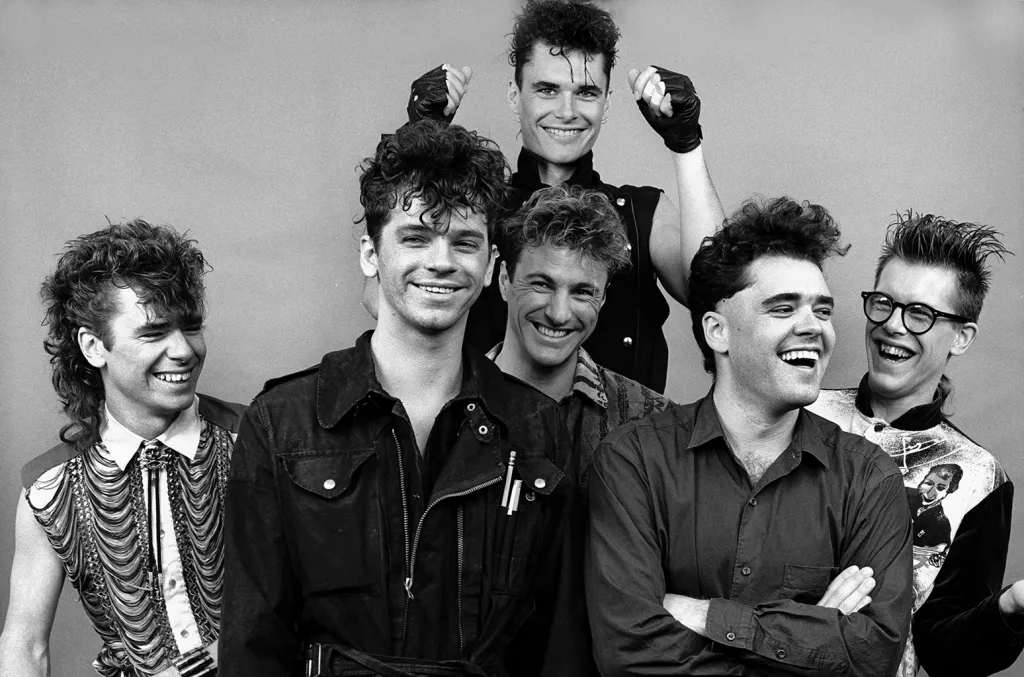
Their first performance under that name took place at the Oceanview Hotel in Toukley, a modest beginning for a band that would eventually sell more than fifty million records worldwide.

Their debut album, titled INXS, was released in 1980 and introduced a band still finding its shape.
The debut showed a band already drawing from several directions at once, new wave, funk, and rock, mixing them without making the joins obvious. It was the sound of a group that knew what they liked and were not interested in choosing just one thing.
What came next was years of work that most people never see and rarely discuss when talking about successful bands. INXS toured relentlessly through the Australian pub and club circuit, playing night after night, tightening their sound, learning what worked in front of real audiences.
Hutchence developed as a performer in those rooms. He learned how to hold a crowd that was not necessarily there to see him, how to make people stop talking and start paying attention, how to use his body and his voice together as a single instrument.
That education cannot be bought or taken as a shortcut. It comes only from repetition, from failure, from the accumulated experience of standing in front of people who do not yet care about you and making them care.
By the time Underneath the Colors came out in 1981 and Shabooh Shoobah followed in 1982, INXS had become a serious presence in Australia.
Shabooh Shoobah was the first album to reach an international audience in any meaningful way, and the single The One Thing became their first U.S. chart entry. It was a glimpse of what was possible, but only a glimpse. The real push was still ahead.
The Swing in 1984 and Listen Like Thieves in 1985 moved the band steadily upward. Listen Like Thieves was the album that sharpened everything. The production was cleaner, the songs were tighter, and What You Need became a genuine international hit, reaching number five in the United States.

For the first time, INXS were not just an Australian act making inroads abroad. They were a band that belonged on the same stage as anyone in the world.
But Kick was the moment everything broke open. Released in October 1987, Kick was the result of Hutchence and Andrew Farriss working at the height of their creative partnership. The album combined rock energy with funk grooves and dance-floor instincts in a way that felt natural rather than calculated.
Need You Tonight opened with a guitar riff so stripped back it almost felt like an afterthought, until Hutchence’s voice arrived and turned the Thing into something you could not look away from, which felt both alive and seductive at once.
His vocal on that track was conversational in tone but electric in effect, the sound of someone completely in control of the space they were occupying. It reached number one in the United States and became the band’s defining single.
Devil Inside had a slow, circling quality that built pressure without releasing it until Hutchence’s chorus arrived. New Sensation was pure momentum, a song that moved like a wave, carrying the listener along.
Never Tear Us Apart was the album’s most emotionally direct moment, built around a saxophone line that opened the track like a door and Hutchence’s voice doing something rare for a rock lead, allowing itself to sound genuinely vulnerable.
He had been in a long relationship with Michele Bennett through much of the 1980s, and the emotional honesty in that song did not come from nowhere else. Kick produced four U.S. Top 10 singles, an achievement that placed INXS among the biggest bands on Earth at the time.
The MTV era suited Hutchence perfectly. He was physically magnetic in front of a camera in a way that translated directly to a screen. He moved with a fluidity that most rock leads did not have, something closer to a dancer’s awareness of the body than the standard guitar-hero swagger.
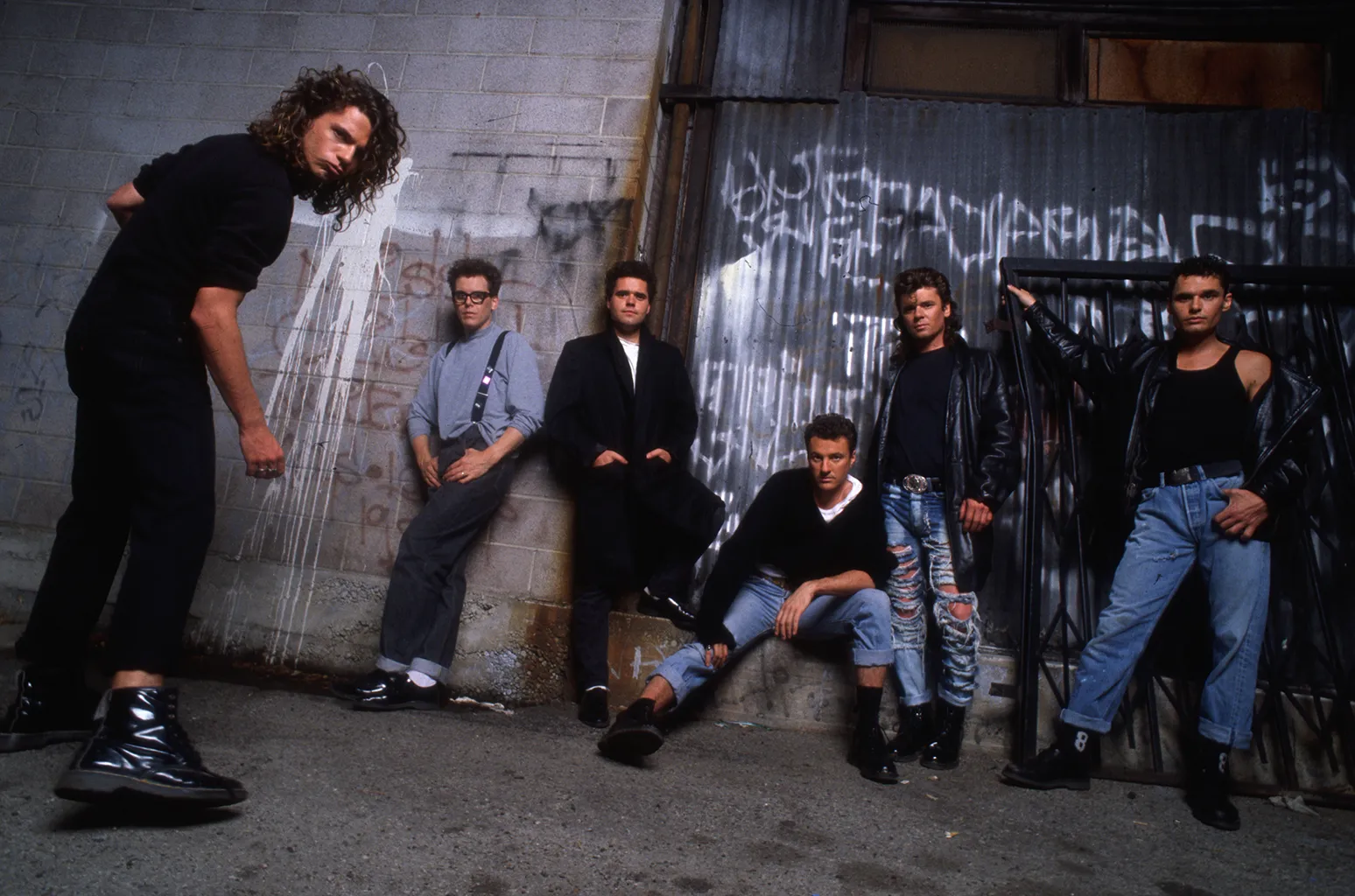
He understood that a music video was not just a promotional tool but a small film, and he performed accordingly. At a time when image was becoming as important as sound in determining a band’s reach, Hutchence gave INXS an image that was international, glamorous, and genuinely cool.
X followed in 1990, showing a band unwilling to repeat themselves. Suicide Blonde, which Hutchence wrote partly in response to Kylie Minogue dyeing her hair blonde during their relationship, had a harder edge than most of Kick’s material.
Disappear had a different feel from the harder singles, more open and less concerned with landing a hook, and the album as a whole reached number two on the UK Albums Chart.
Hutchence was now one of the most recognizable faces in rock, photographed constantly, followed wherever he went, and romantically linked to a succession of public figures whose own fame amplified his.
Away from the spotlight, he was described by people who knew him as thoughtful, shy, and genuinely curious. He read widely, cared about film, and was interested in the world in ways that went beyond music.
His public persona, the sensual, dangerous frontman in tight leather, was real. Still, it was also a performance, and the person behind it was more complicated and more fragile than the image suggested.

In 1992, everything changed.
In Copenhagen, following an argument outside a taxi, Hutchence was assaulted and fell, hitting his head on the pavement. The injury was serious. He suffered damage that left him with a partial loss of his sense of smell and taste, two senses that had been important to him in ways that went beyond the physical.
Friends and colleagues noted changes in his mood and behavior in the years that followed. He became less stable, more prone to depression, and more difficult to reach. The warmth that had always been part of his private personality became harder to access. The injury had done something to him that could not be undone.
Welcome to Wherever You Are came out in 1992 and was, in many respects, one of INXS’s most ambitious albums, incorporating orchestral arrangements and moving away from the polished sound of the Kick era. Full Moon, Dirty Hearts, released in 1993, was recorded during a period of increasing personal difficulty for Hutchence.
The sessions were reportedly troubled. The mood within the band was strained. The album did not perform as well as its predecessors, and the shift in the musical landscape toward grunge and alternative rock had moved mainstream attention away from the kind of music INXS made.
Elegantly Wasted, released in 1997, was the last INXS album made with Hutchence. There are moments on that record where his voice sounds as strong and as assured as it ever had, which makes the album both a comfort and a painful thing to listen to in retrospect.
The title track, in particular, has a looseness and swagger that recall the band’s best years.
Hutchence spent the mid-1990s in a period of personal turbulence. His relationship with Paula Yates, who had been married to Bob Geldof, became a fixture of tabloid coverage across Britain and Australia.
Hutchence and Paula Yates first crossed paths in 1985 when she interviewed him for the British television program The Tube. Nothing came of it then.
Yates was married to Boomtown Rats singer Bob Geldof, and Hutchence moved on through a series of relationships, including a long-term relationship with Helena Christensen, one of the most recognizable faces in the modeling world at the time.

It was not until 1994, when Yates interviewed him again for her Channel 4 show The Big Breakfast, that something shifted between them. The affair became public, and the reaction was immediate. People could not understand why Hutchence had walked away from Christensen.
The British press, which had always been fond of Geldof following his work with Band Aid and Live Aid, treated Yates harshly and Hutchence as the man who had broken up a family. The scrutiny was relentless and often cruel. Yates separated from Geldof in February 1995, and their divorce was finalized in May 1996.
By then, Yates was already pregnant. Tiger Lily was born on 22 July 1996 in the bathroom of their London home, with Hutchence helping with the delivery. He was, by all accounts, devoted to his daughter from the moment she arrived.
He had a dream during that period of moving the whole family permanently to Australia, away from the cameras and the courtrooms, somewhere Yates could work in television, and he could focus on music.
That dream never had a chance to become real. Yates was already fighting with Geldof over their three daughters, Fifi, Peaches, and Pixie. However, Geldof won a court order preventing her from taking his daughters out of the UK. Yates walked out of the courtroom that day and told her solicitor, “This will kill Michael.”
On the evening of 21 November, two friends visited Hutchence in his room at the Ritz-Carlton hotel in Sydney’s Double Bay suburb. They stayed until around five in the morning. Those who were there said he talked about Yates, Tiger Lily, the custody situation, and how much he wanted his daughter to be with him. He was not at peace.
At 9:38 the following morning, he left a voicemail for his manager, Martha Troup. The message was seven words. “Martha, Michael here. I fucking had enough.” He was found dead in his hotel room later that day. He was 37 years old.
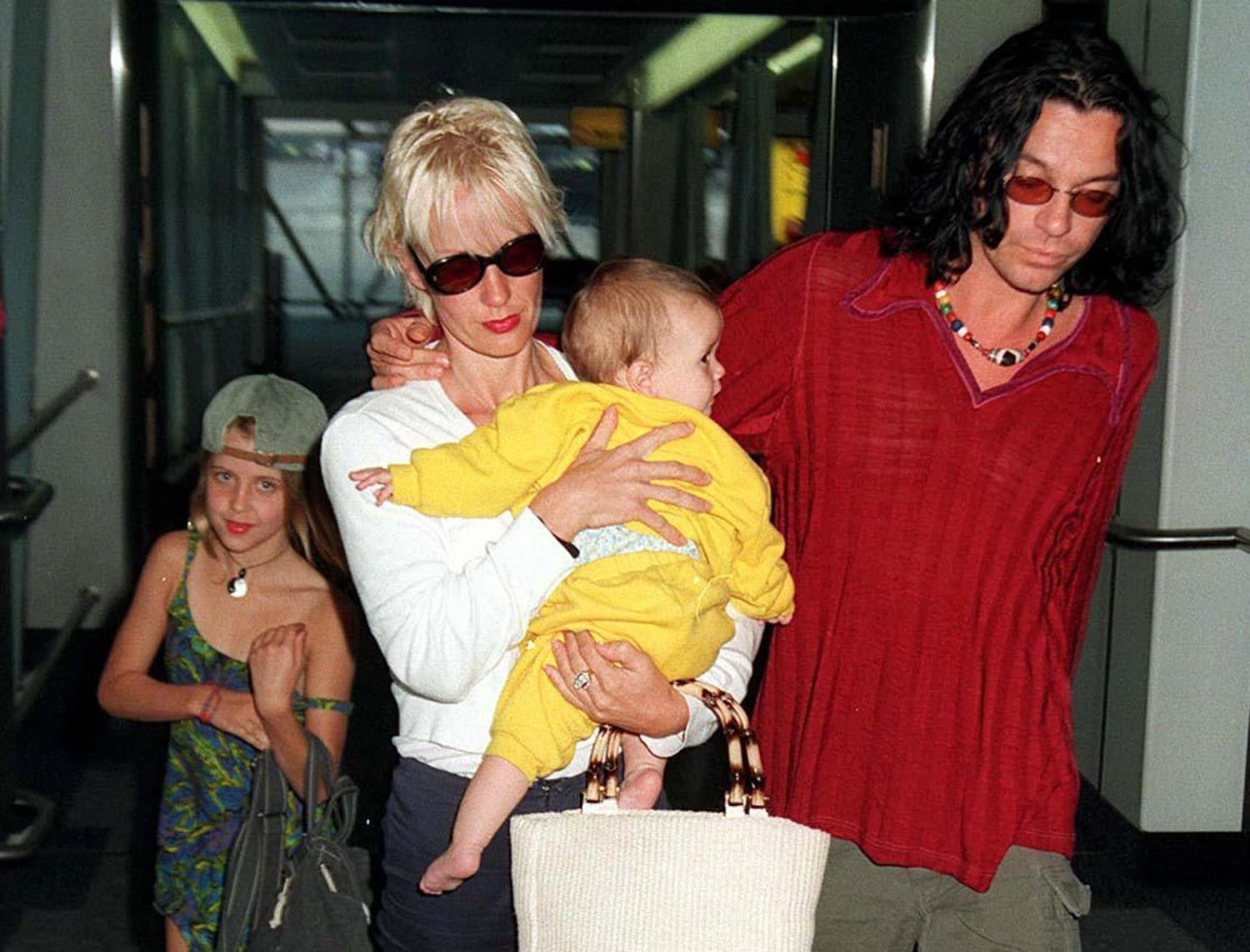
Yates never accepted the suicide verdict and never recovered from losing him. She died of a heroin overdose in September 2000. Tiger Lily was four years old when she lost her father. She was four when she lost her mother, too.
Geldof took in the little girl and raised her alongside her half-sisters. In 2007, he adopted her, and her name became Heavenly Hiraani Tiger Lily Hutchence-Geldof.
INXS continued after his death. They tried various configurations over the years, including a televised search for a new singer in 2005 that produced J.D. Fortune, who fronted the band for a period before the arrangement ended. They performed and recorded in different forms until 2012, when they announced they would stop.
The post-Hutchence years produced moments of genuine music but never replaced the chemistry that had made the original band what it was. His absence was too large to fill.
What he left behind is a catalog that has not aged as much as much of its era has. Need You Tonight still sounds current. Never Tear Us Apart still carries the same emotional weight it carried in 1987.
The records hold because the performances inside them were real. After all, Hutchence brought something to every vocal that was uniquely his and could not be replicated or replaced.
He was a frontman who understood that the job was not just to sing the song but to make the listener believe it. He did that consistently, across fifteen years of records and tours, through personal joy and private pain and everything in between.
For nearly two decades, he was the reason INXS connected with audiences across continents and cultures, and when he was gone, the band never found a way to replace what he had brought to it.
INXS sold more than fifty million records because of many things: Andrew Farriss’s songwriting and musical instincts, the band’s years of relentless work, and the perfect timing of Kick in the MTV era. But the reason those records reached people, the reason they stayed with people, was Michael Hutchence.
He was the voice. He was the face. He was the reason you believed every word.