
From childhood polio and early Winnipeg bands to Buffalo Springfield, Crazy Horse, CSNY, and decades of reinvention, Neil Young built one of modern music’s most unpredictable careers.
Neil Young was born Neil Percival Young on November 12, 1945, in Toronto, Canada. His father, Scott Young, was a well-known journalist and sports writer. His mother, Edna, known as Rassy, came from a different background.
He had an older brother, Bob, and in his earliest years, he was simply a child growing up in postwar Canada. A lot changed when health problems entered his life.

At the age of five, Young contracted polio. He survived, but the illness left physical effects, especially on his left side, and those effects became part of his life rather than a brief episode.
Recovery shaped him not only physically but psychologically. His family even spent time in Florida during a recovery period, trying to improve his condition. When people later described Neil Young as stubborn, physically driven, and strangely resilient, his early-life experience with illness helps us understand why.
He had already learned as a child that the body could fail and still be pushed forward.
His parents’ marriage did not last. When he was around twelve, they divorced, and that split was another major turning point in his childhood life. He moved with his mother to Winnipeg, and that relocation shaped his music far more than Toronto had.
Winnipeg in the late 1950s and early 1960s provided him with access to a growing rock-and-roll scene. He listened closely to Elvis Presley and other early rock figures, and the teenage band years began there.
Young formed early groups, such as the Jades and, later, the Squires. These bands were part of his real education.
He dropped out of formal schooling because music had become the center of his life. In Winnipeg, he was not yet the Neil Young people later knew, but the core traits were already visible. He was writing songs, playing in bands, and moving toward a style that was not fully folk, not fully rock, and not interested in staying in one category.
One of the songs from those early years was “Sugar Mountain,” which later became a key piece in understanding his youth and early self-awareness.
Even before major fame, Young was already writing in a way that mixed observation, memory, and unease. He was not simply trying to write hit material. He was trying to write what he saw and felt.
In 1966, he made the move that changed everything. He traveled to Los Angeles with bassist Bruce Palmer in a hearse, a detail that has become part of rock mythology because it captures the strange mix of desperation and confidence behind the journey.
Once in California, he connected with Stephen Stills and Richie Furay, and Buffalo Springfield was formed.
Buffalo Springfield was one of the key bands of the late 1960s folk-rock movement, but what matters here is that the band contained strong personalities and strong writers with constant instability. Their success came early, and tension followed just as fast.
Young’s songwriting and guitar style were already distinctive inside the group. “Mr. Soul” showed his harder edge. “Expecting to Fly” showed his interest in mood, structure, and emotional space.
Even though “For What It’s Worth” became the group’s defining song, written by Stephen Stills, Buffalo Springfield as a whole established Young as a major figure very early in his career.
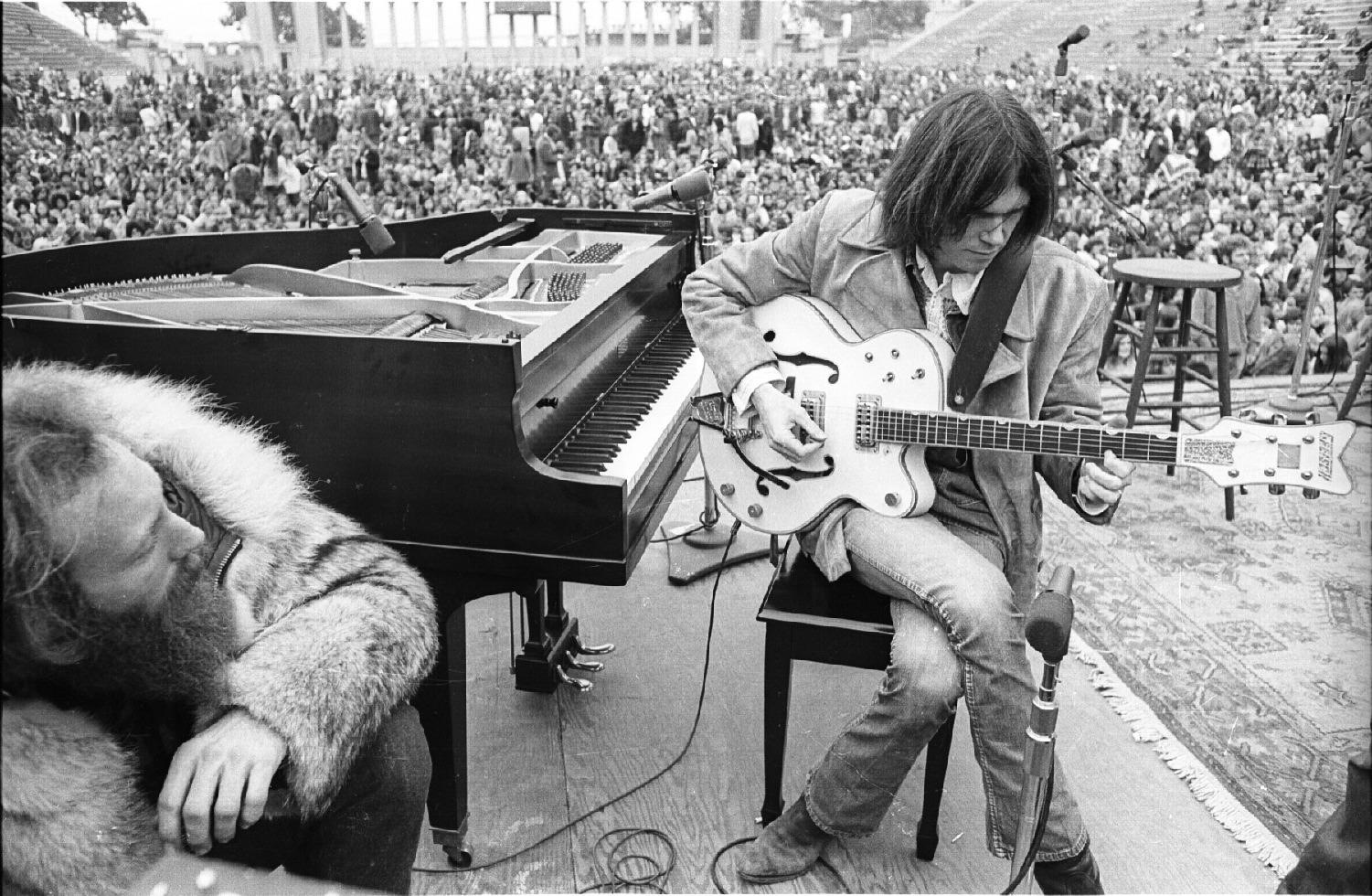
The band released three albums before breaking apart in 1968, and the breakup was driven by reasons that would recur throughout Young’s life. Strong talent, weak stability, and an inability to stay still for long.
After Buffalo Springfield ended, Young moved into solo work, but the solo path was not cleanly separate from band work. His 1969 debut album, Neil Young, introduced him as an individual artist, but it was Everybody Knows This Is Nowhere, released later that same year with Crazy Horse, that really defined his electric identity.
Crazy Horse, with Danny Whitten, Billy Talbot, and Ralph Molina, became one of the central relationships of his career. Their sound was loose, raw, and emotionally direct. Long songs like “Down by the River” and “Cowgirl in the Sand” stood out because they did not follow the structure of typical radio rock.
They stretched out, leaned into repetition, and treated the electric guitar as a way of thinking rather than just decorating a track. “Cinnamon Girl” showed the same band in a tighter frame, with one of Young’s most durable riffs.
Also in 1969, Young joined Crosby, Stills, and Nash, forming Crosby, Stills, Nash, and Young. This gave him entry into one of the most commercially powerful formations of the era, but it also placed him inside another unstable alliance.
CSNY could produce extraordinary work, and Déjà Vu in 1970 confirmed that. The album reached number one and became one of the defining records of the era.
Young’s role in the group became clear early on. His writing and guitar work added a rougher edge and a more personal, reflective tone, setting him apart within the band. His song “Helpless” remains one of the album’s emotional centers.
He also wrote “Ohio” after the 1970 Kent State shootings, and the song showed his ability to respond to political events with clarity and force.
At the same time, his solo career continued to move. In 1972, Harvest made him a much bigger commercial figure than before. “Heart of Gold” became his number one single, and the album sold in huge numbers. “Old Man” also became one of his best-known songs, tied in part to life at Broken Arrow Ranch, the California property that became central to his image and personal life.
Harvest placed him at the center of the singer-songwriter boom, but he was uncomfortable with the kind of fame it produced. This is one of the recurring patterns in Neil Young’s career. The moment he reached a stable, highly visible commercial position, he often moved away from it.
His personal life in the early 1970s also strongly influenced his music. He was in a relationship with actress Carrie Snodgrass, and in 1972, their son Zeke was born. Zeke had cerebral palsy. It changed his priorities and directed his focus on family, security, and long-term responsibility.
At the same time, tragedy entered the music around him. Danny Whitten, the guitarist from Crazy Horse and one of Young’s closest musical partners, died of a drug overdose in 1972. That death had a huge impact on Young and fed directly into what later became known as the Ditch Trilogy.
Instead of following Harvest with something safer or cleaner, he turned into darker, more damaged material. Time Fades Away in 1973, On the Beach in 1974, and Tonight’s the Night in 1975 carried grief, dislocation, anger, and exhaustion.
These albums are central to understanding Young because they show how he responded to success and loss. He did not polish grief into something easily marketable. He left it rough.
In 1975, another important phase began when he worked again with Crazy Horse and released Zuma. This album restored some energy after the darkest period, and songs like “Cortez the Killer” became major parts of his catalog. Even when the lyrics were historical or symbolic, the emotional atmosphere remained intense.
In the late 1970s, his family life changed further. In 1978, he married Pegi Young. They would remain together for decades and have two children, Ben and Amber. Ben, like Zeke, had cerebral palsy. Amber later developed as an artist and also lived with epilepsy, a condition Neil himself had experienced.
These family realities had long-term effects on his life and work. They pushed him toward advocacy and gave his private life a sense of stability that did not match the public image of a restless rock musician.
Also in 1978, Comes a Time showed another side of Young, more rooted in country and acoustic textures. Then, in 1979, Rust Never Sleeps became one of his key albums. It brought together acoustic material and electric force in a way that captured the two main sides of his music.
“My My, Hey Hey” and “Hey Hey, My My” framed the album’s themes of survival, obsolescence, and artistic endurance. This record later became central to how younger musicians understood him, especially in alternative and grunge circles.
The 1980s were a difficult but revealing period. Young refused to repeat himself, and that refusal led to one stylistic shift after another. Some listeners admired the risk. Others were confused by it. He moved through rockabilly, country, electronic experimentation, and other forms without much concern for commercial logic.
Trans in 1982 is especially important because the use of synthesizers and vocoder-like vocals was partly tied to his efforts to connect with his son Ben and to think about communication differently. This was not simply an experimental whim. It had a family context.
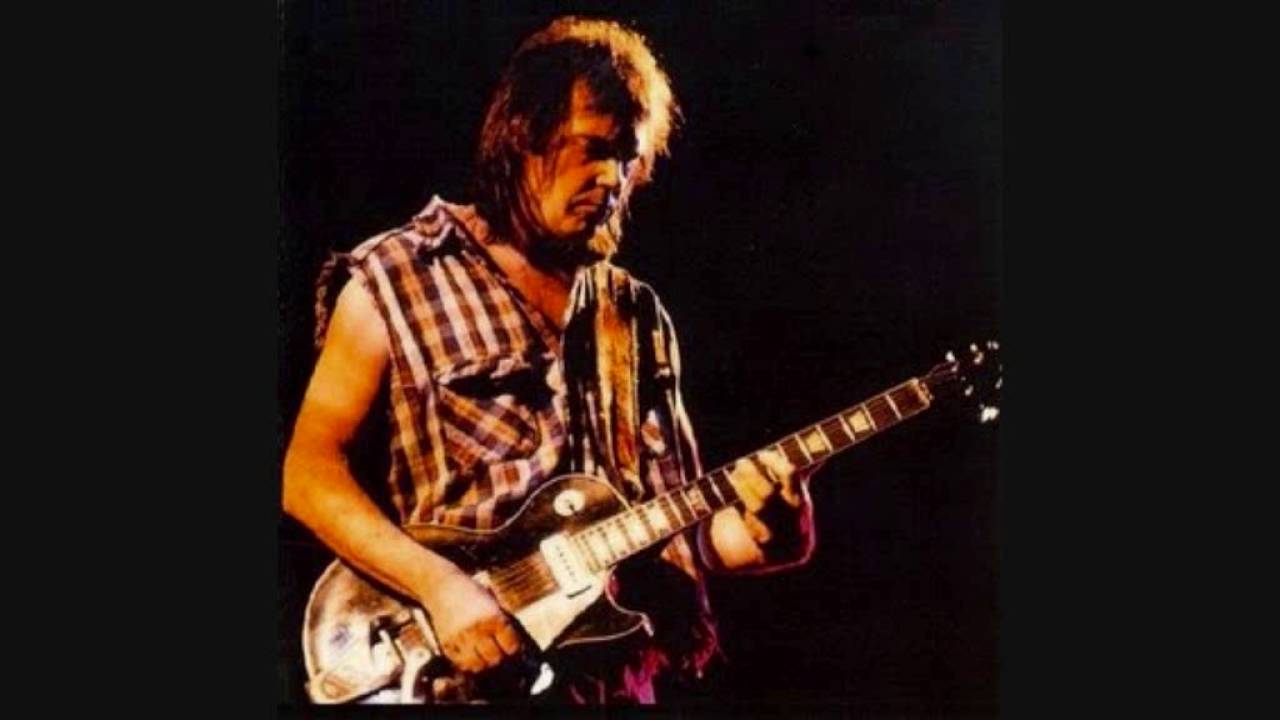
His label, Geffen, reacted badly to some of these changes and even sued him, accusing him of delivering music that was not recognizably “Neil Young.” That lawsuit says a lot about Young’s career. He was one of the few major artists who could become legally controversial for refusing to repeat his own brand.
In 1985, he co-founded Farm Aid with Willie Nelson and John Mellencamp. This was not an image move. It became one of the longest-running activist commitments of his life. He used his position to support family farmers and criticize industrial agriculture. Environmental concern, which had been present in songs like “After the Gold Rush,” became more explicit over time.

By the late 1980s, Young’s music took on a stronger and more defined edge again. Freedom in 1989 brought him back into stronger public focus and included “Rockin’ in the Free World,” one of his major late-career songs.
Then, in 1990, Ragged Glory with Crazy Horse delivered a huge, distorted guitar sound that helped explain why younger musicians responded to him so strongly.
This is where the “Godfather of Grunge” label became fully understandable.
Bands such as Nirvana and Pearl Jam heard in Young’s electric work a model for roughness, feedback, emotional honesty, and a refusal to smooth the edges.
The early 1990s also brought one of his most commercially and emotionally successful later albums, Harvest Moon, in 1992. This record reflected a more settled, reflective phase than the intensity of his earlier years, and its title track became one of his most-loved songs.
Kurt Cobain admired him deeply and quoted the line “It’s better to burn out than to fade away” from “Hey Hey, My My” in his suicide note.
Young was disturbed by this and later wrote that the note hit him hard. He had tried to reach Cobain before his death. Young’s influence on grunge became emotionally entangled with one of the movement’s darkest moments.
In 1994, after Cobain’s death, Young released Sleeps with Angels, which carried grief without reducing it to tribute alone.
In 1995, Young worked with Pearl Jam on Mirror Ball. The collaboration made sense historically because Pearl Jam had long admired him, but it also worked musically. The record captured a raw, instinctive energy that aligned well with both Young’s Crazy Horse side and Pearl Jam’s heavier instincts.
The sessions were straightforward and largely unpolished. They were also symbolically important. A figure from the late 1960s and early 1970s had connected directly with one of the central rock bands of the 1990s without sounding artificial.

His later career kept moving in different directions. Greendale, in 2003, brought a narrative, concept-driven structure. In 2005, after surviving a brain aneurysm, he released Prairie Wind, an album shaped by age, mortality, and reflection.
His activism also intensified across the 2000s and 2010s. He pushed against fossil fuels, industrial agriculture, and corporate power. He opposed tar sands development, supported rainforest technology projects, and released The Monsanto Years in 2015 as an explicit attack on agribusiness and GMO-related corporate practices.
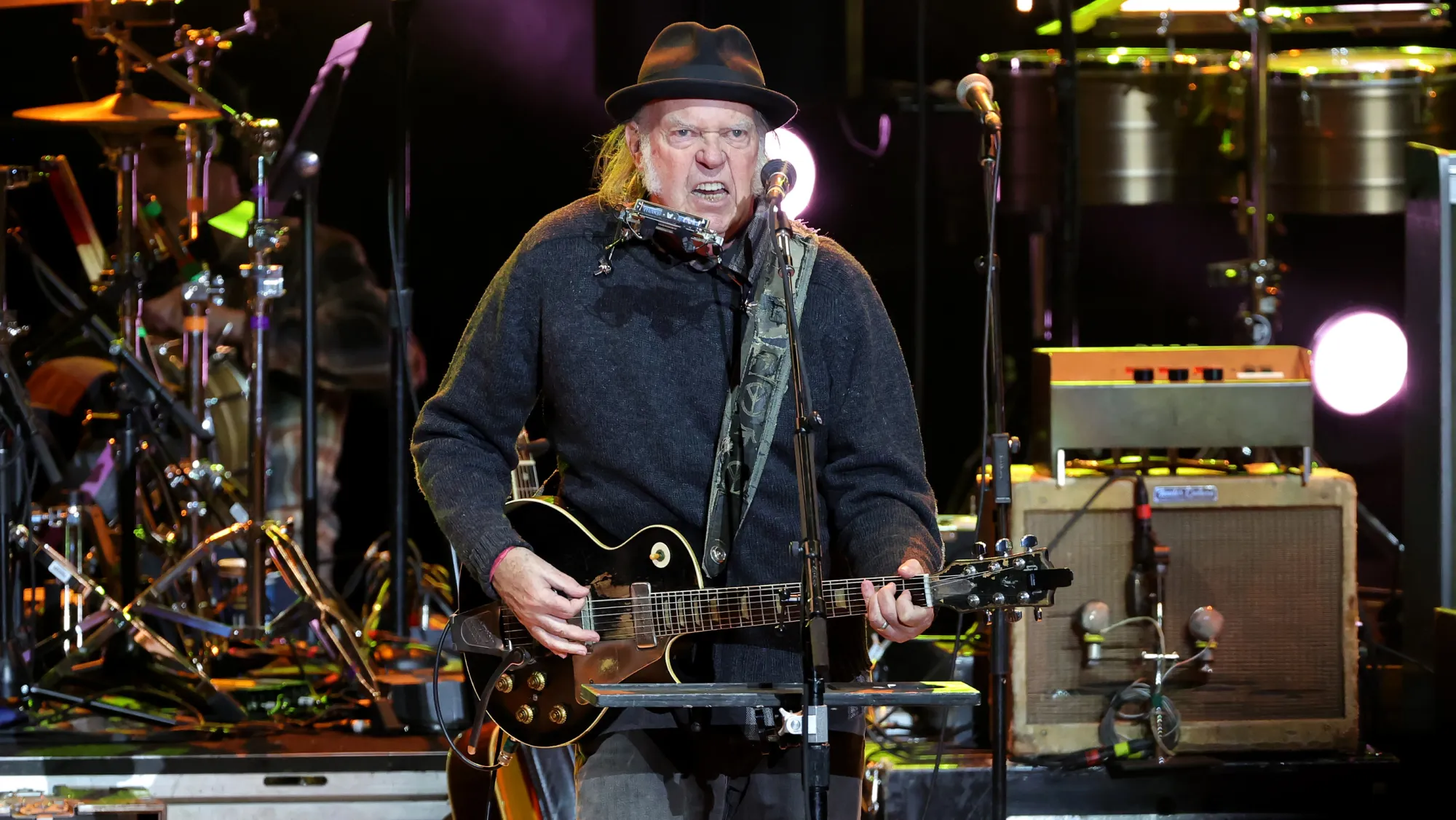
With Daryl Hannah, whom he married in 2018, he also continued connecting environmental politics with touring practices, including biodiesel transport and more sustainable concert models.
His family life remained central through all of this. The Bridge School, founded with Pegi Young, became one of the most significant long-term expressions of his private commitments. It was built around the needs of children with severe speech and physical impairments, directly shaped by the realities of his sons’ disabilities. When Pegi died in 2019, it closed one of the most important personal chapters of his life.
Musically, he kept recording with Crazy Horse into the 2010s, including Psychedelic Pill in 2012 and Colorado in 2019. He also continued to open the archives, release older recordings, and show how much of his history had been stored but not fully heard. By the 2020s, his body of work had become one of the largest and most varied in rock history.
Neil Young’s career only makes sense if the contradictions stay visible. He is a folk writer, a country singer, a distorted guitar player, a grunge influence, a family man shaped by disability advocacy, and an environmental activist who often treats politics as inseparable from music.
He moved from polio in childhood to decades of touring, from Buffalo Springfield to CSNY to Crazy Horse, from Harvest to Tonight’s the Night to Mirror Ball to later archival projects. He rarely chose the simplest direction, and he almost never stayed in one lane long enough for the industry to define him fully.
That is the reason his work has lasted. He kept changing, but the core remained the same.