
From a working-class childhood in New Jersey to the poetry, punk, love, and loss that shaped one of music’s most distinctive careers
Patricia Lee Smith was born on December 30, 1946, in Chicago, Illinois. Long before she became known as Patti Smith, long before she stepped onto the stage at CBGB or recorded Horses, she was a shy child growing up in a family that rarely had much money and often had to move wherever opportunity appeared.
Her father, Grant Smith, worked factory jobs. Her mother, Beverly Smith, worked as a waitress and carried strong religious convictions through her involvement with the Jehovah’s Witnesses faith. Patti was the eldest of four children, which meant responsibility arrived early.
The family spent time in Philadelphia before eventually settling in South Jersey, particularly around the Deptford and Woodbury area. Home was often modest. Money remained tight. Stability was something the family worked toward rather than something they automatically possessed.
The religious environment inside the household left a deep impression on Smith.
Bible study formed part of everyday life. Religious literature filled the home. The children participated in door-to-door ministry work. The experience gave Smith early exposure to ideas about faith, morality, judgment, and belief. She would eventually move away from organized religion, but those early years remained embedded in her imagination.
At the same time, another influence was developing.
Books.
Smith often felt disconnected from the expectations placed on young girls during the 1950s and early 1960s. While many of her peers focused on fitting in, she spent long periods reading. Literature offered a world much larger than the neighborhoods she knew.
Among the writers who most influenced her was the French poet Arthur Rimbaud.
She discovered him as a teenager and became captivated by both his writing and his life story. Rimbaud represented something powerful: a person who treated art as an act of freedom rather than a career path. That idea stayed with her for the rest of her life.
The Beat writers also entered her world.
Writers who challenged convention, questioned authority, and treated personal experience as artistic material became companions during her teenage years. Their influence can be heard throughout her later work, where poetry and music rarely exist separately.
Music entered alongside literature.
She absorbed rock and roll records, rhythm and blues, soul music, and the artists who were reshaping popular culture during the 1960s. Unlike many future musicians, she did not initially imagine herself as a singer.
She wanted to be an artist.
The form that art would eventually take remained unclear.
After graduating from high school, Smith enrolled at Glassboro State Teachers College, intending to become an art teacher. The decision seemed practical as teaching offered security and structure.
The experience did not last; college failed to hold her attention, and financial pressures continued to shape her daily life. To support herself, she took factory work.
Those months became some of the most important in her development.
Factory life exposed her to repetitive labor, exhaustion, and the realities working-class Americans face. The environment felt restrictive and disconnected from the creative life she imagined for herself.
Years later, those experiences would reappear in her writing and songs, most famously in “Piss Factory,” one of the earliest recordings associated with her career.
Around this same period, another life-changing event occurred.
At nineteen, Smith became pregnant.
She gave birth to a daughter and made the difficult decision to place the child for adoption.
The experience affected her deeply.
It also forced her to confront questions about the future far earlier than most people her age. School no longer felt like the answer. Factory work felt like a dead end. Remaining where she was seemed increasingly impossible.
New York became the destination.
In 1967, Patti Smith arrived in New York City with very little money, very few connections, and no clear plan beyond the desire to become an artist.
The city she entered was very different from the New York that tourists know today.
Many parts of Manhattan were rough, neglected, and inexpensive. Artists, musicians, photographers, writers, and performers often survived through temporary jobs, shared apartments, and whatever opportunities they could find.
For Smith, survival came first. Art came second. The two eventually became inseparable.
One of the most important encounters of her life occurred shortly after she arrived in the city.
She met a young artist named Robert Mapplethorpe.
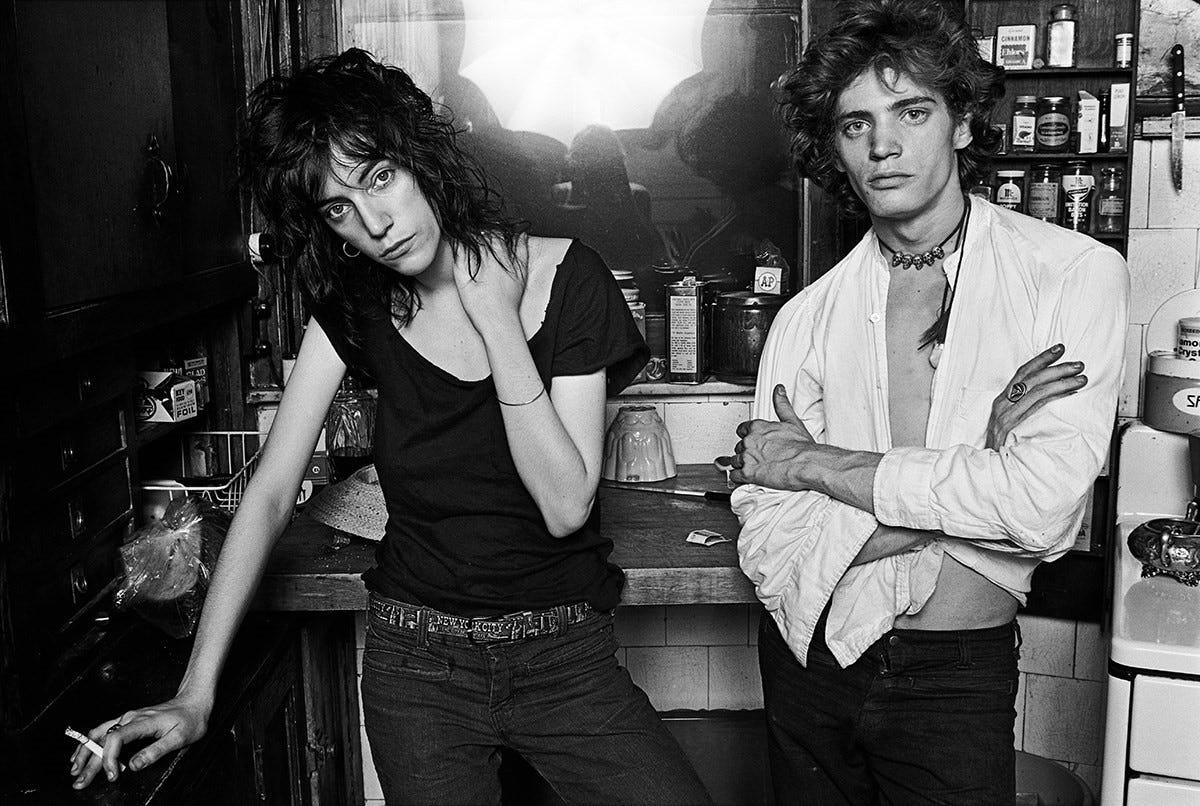
At the time, neither of them was famous nor had an established career.
Their relationship became one of the most significant creative partnerships in modern American art.
They supported each other financially when money was scarce. They encouraged each other’s ambitions. They shared apartments, ideas, and dreams during years when success seemed distant.
Mapplethorpe was developing as a visual artist. Smith was developing as a writer.
Together they helped shape each other’s identities. The importance of that relationship cannot be separated from Patti Smith’s later career.
Many musicians have collaborators. Few have relationships that become foundational to their entire artistic development.
Mapplethorpe gave Smith confidence at moments when she doubted herself.
Smith provided support as he developed the artistic vision that would later make him one of the most influential photographers of his generation.
During these years, Smith immersed herself in New York’s creative world.
She worked in bookstores, wrote poetry, and attended performances. She met artists, playwrights, musicians, and writers.
Among the important figures entering her life was playwright Sam Shepard.
Their relationship included both romance and creative collaboration. Shepard recognized something unusual in Smith’s writing and encouraged her development as a performer.
Around the same time, another crucial connection formed. Smith met Lenny Kaye.
Kaye had worked as a music journalist and shared Smith’s deep appreciation for rock history. Their partnership would become one of the defining relationships of her musical life.
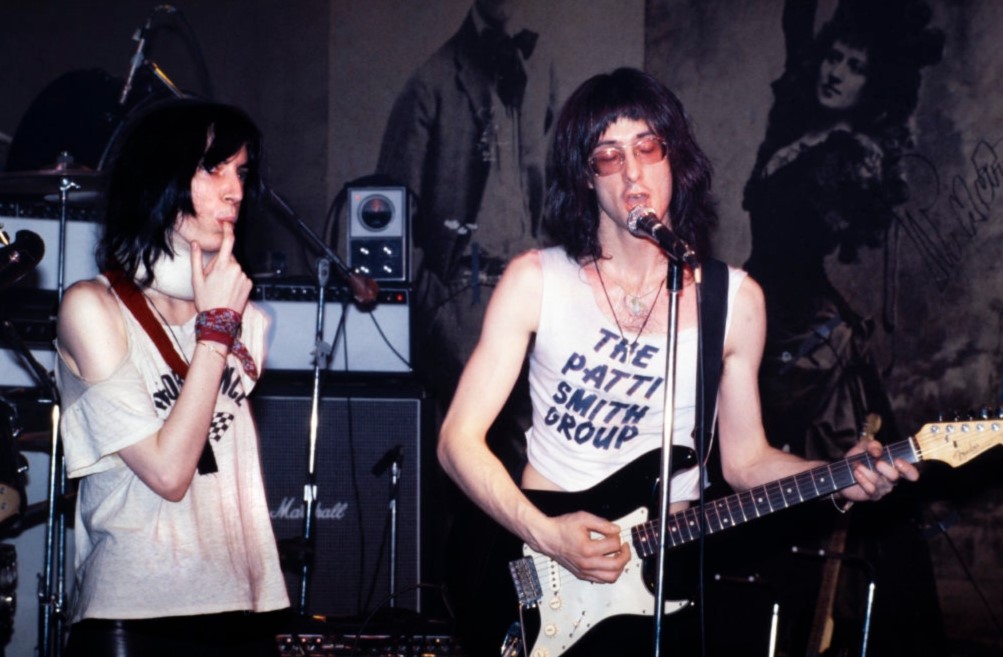
Initially, the collaboration revolved around poetry readings. Smith would read her work while Kaye would accompany her on guitar.
During the sessions, something unexpected happened. The boundary between poetry and music began to disappear.
The performances carried the emotional force of spoken words while drawing energy from rock and roll. Audiences responded because they were seeing something difficult to categorize.
Smith was not behaving like a traditional poet or a conventional singer. She was building something that occupied the space between the two worlds.
By the early 1970s, that combination was beginning to attract attention throughout New York’s downtown art community.
CBGB, Horses, and the years that placed Patti Smith at the center of a new movement in American rock music
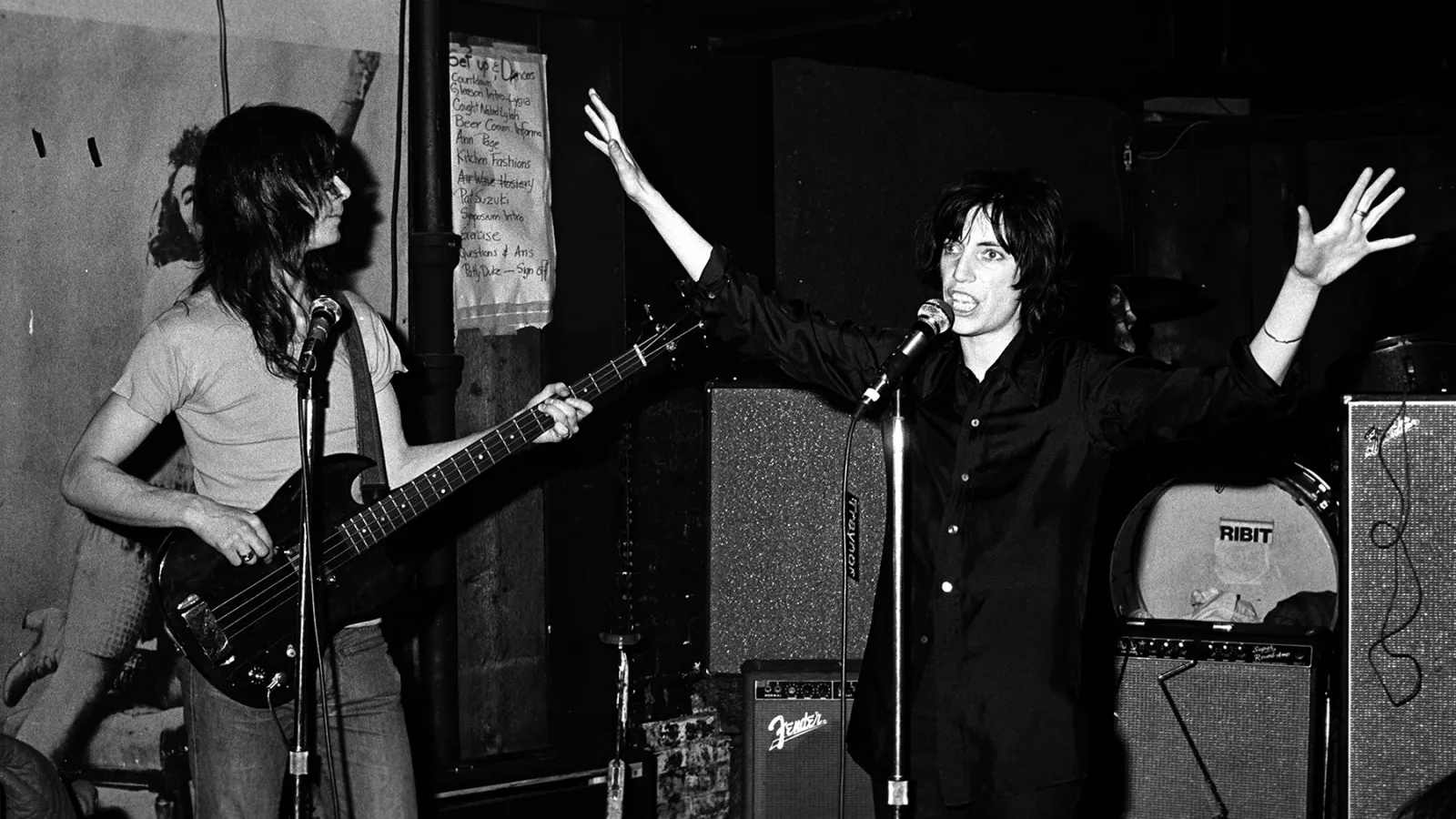
By the early 1970s, Patti Smith had built a reputation in New York’s downtown arts scene, but she was still better known as a poet than a musician.
Her performances with Lenny Kaye had created something unusual. Poetry readings were no longer on the page. The guitar entered the picture. Improvisation entered the picture. Rock and roll entered the picture.
The audience watching these performances often did not know exactly what they were seeing.
That uncertainty became one of Smith’s strengths.
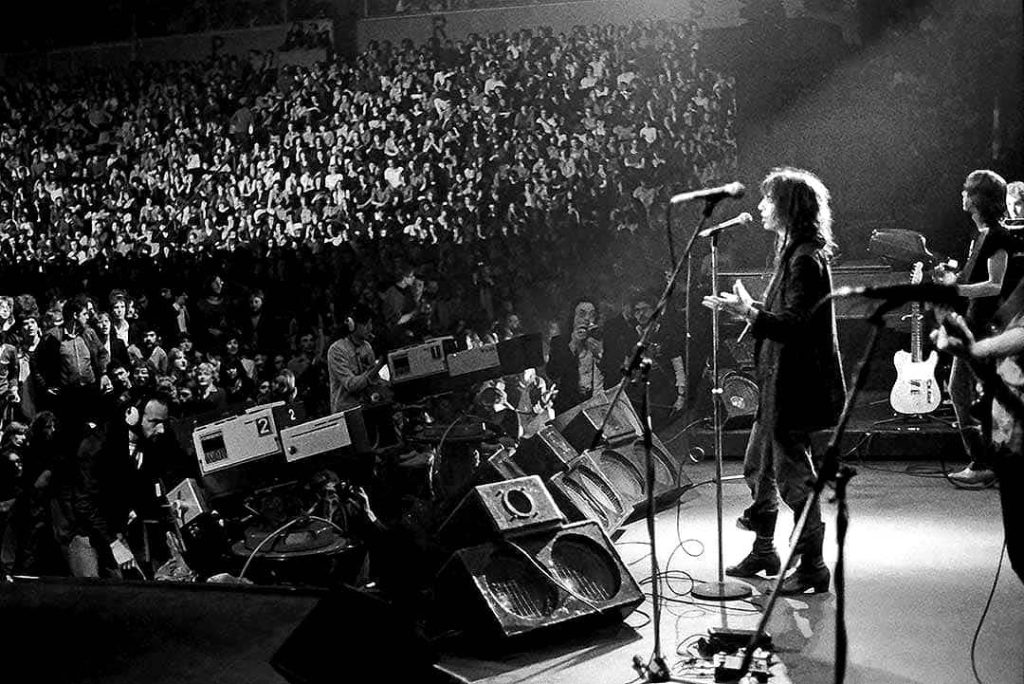
She had little interest in following established rules. She was not trying to become a folk singer, a traditional poet, or a mainstream rock performer. The goal was expression, and whatever form served that purpose was welcome.
As the performances grew, so did the lineup around her.
Lenny Kaye remained central. Keyboardist Richard Sohl joined the developing group. Guitarist Ivan Král eventually entered the fold. Drummer Jay Dee Daugherty helped complete the lineup that would become the Patti Smith Group.
At the same time, New York itself was changing.
The city faced economic problems, rising crime, and widespread decline in many neighborhoods. While politicians and business leaders worried about the city’s future, artists found opportunity in abandoned spaces, low rents, and freedom from commercial expectations.
Out of that environment emerged a collection of musicians who would reshape American rock.
A small club on the Bowery became one of the focal points.
CBGB.
The venue would later become famous worldwide, but in its early years, there was no guarantee of greatness.
The room was small, with basic equipment and inconsistent audiences.
Yet within those walls, several important bands began building their reputations.
Television developed a guitar-driven sound built around long, intricate arrangements.
Ramones stripped rock music down to its essentials and delivered songs at breakneck speed. Talking Heads approached songwriting from an entirely different angle, combining art-school sensibilities with sharp observation. Blondie brought pop instincts into the emerging scene.
Patti Smith occupied her own corner of this world.
Her performances carried the energy of rock music, the language of poetry, and the attitude of someone completely uninterested in fitting expectations.
Critics would later describe her as one of punk’s founding figures.
At the time, most participants were simply trying to create something different from what dominated radio and arenas.
Smith’s stage presence stood out immediately.
She walked onto stages dressed in men’s shirts, jackets, and simple clothing rather than the glamorous image expected of female performers. Her appearance reflected practicality and personal comfort rather than fashion trends.
More importantly, her performances carried conviction.
She recited poetry, improvised, stretched songs into spoken-word passages, quoted literature, and challenged audiences.
People often left her shows with strong opinions. Some loved what they saw, while others left confused, but very few remained indifferent.
The growing reputation of the Patti Smith Group led to an important opportunity.
In 1974, Smith released her first single, “Hey Joe,” backed with “Piss Factory.”
The release offered listeners an early glimpse of what made her unique.
“Hey Joe” reworked a familiar song through Smith’s perspective, while “Piss Factory” drew directly from her own experiences working factory jobs and dreaming of escape.
The record attracted attention inside music circles and helped establish her identity beyond poetry readings.

The momentum continued building.
Soon afterward, Patti Smith became the first artist associated with the CBGB scene to sign with a major label.
Arista Records saw potential where many others saw risk. The decision would produce one of the most influential debut albums in rock history.
Horses arrived in November 1975.
The album remains difficult to describe because it refuses to fit into a single category.
Poetry sits beside garage rock, spoken word appears alongside traditional songs, and literary references share space with raw guitar work.
The record sounds loose at times and carefully constructed at others. Everything works together because Smith’s voice ties it together.
The album opens with “Gloria.”
The first line immediately separated Patti Smith from much of the rock world around her: “Jesus died for somebody’s sins but not mine.”
The statement shocked some listeners and thrilled others.
It announced that this was an artist willing to challenge expectations from the very beginning.
The song itself transformed a familiar rock-and-roll structure into something personal and confrontational.
Producer John Cale played an important role in shaping the album.
Cale understood both experimental music and rock music, making him an ideal collaborator for Smith. Under his guidance, the record preserved the energy of her live performances while giving the songs enough structure to reach a wider audience.
Tracks such as “Birdland” demonstrated her gift for blending narrative, imagery, and performance into something larger than conventional songwriting.
“Free Money” explored themes of family struggles and dreams of escape.
“Land” expanded into a sprawling piece that moved through multiple sections while maintaining emotional force.
The album cover became almost as famous as the music itself.
Photographed by Robert Mapplethorpe, the image showed Smith standing against a plain background, jacket slung over her shoulder, staring directly into the camera.
The photograph carried confidence without posing. Strength without theatrics. It became one of the defining images of the era.
When Horses reached audiences, the response was remarkable.
The album entered the Billboard Top 50 despite receiving very little traditional radio support.
Critics praised its originality, musicians studied it, and young artists saw new possibilities in what rock music could be.
The record demonstrated that poetry, literature, and rock music could coexist without compromise.
Its influence spread far beyond sales figures. Many future punk musicians pointed to Horses as a defining moment.
Others found inspiration in Smith’s refusal to follow conventional expectations for women in rock.
Horses established Patti Smith as one of the most distinctive voices to emerge from New York’s underground music scene. The question now was whether she would follow that success or take an entirely different direction.
In 1976, she released Radio Ethiopia.
The album pushed deeper into improvisation, noise, and experimentation. Listeners expecting another Horses often found themselves surprised.
The record carried heavier guitars, more aggressive performances, and a willingness to take risks.
Critical reaction became more divided. Some admired the ambition, while others struggled with its rougher approach.
Yet the album revealed something important about Smith.
She had no interest in becoming predictable.
Throughout these years, the Patti Smith Group developed into a formidable live act.
Concerts often stretched beyond standard structures. Poetry, improvisation, rock songs, and spontaneous moments blended together.
Audiences attended knowing that no two performances would be identical. Meanwhile, Patti Smith’s reputation continued expanding.
She was increasingly viewed as a bridge between different artistic worlds. Writers respected her literary influences. Musicians respected her commitment to performance. Artists respected her independence.
As the decade drew to a close, another album would bring her largest audience yet. The project was called Easter.
And at its center sat a song that would introduce Patti Smith to millions of listeners who had never set foot inside CBGB. That song was “Because the Night.”
Because the Night, family life, loss, return, and the legacy of an artist who never separated poetry from rock and roll
By the late 1970s, Patti Smith had already achieved something few artists manage in a lifetime. She had established herself as one of the defining figures of New York’s emerging punk scene. Yet commercial success on a larger scale remained elusive.
That changed with Easter.
Released in 1978, the album arrived at a moment when Smith’s songwriting, stage experience, and growing confidence as a bandleader were all coming together. While Horses announced her arrival and Radio Ethiopia explored more aggressive territory, Easter felt focused and fully formed.
At the center of the album was “Because the Night.”
The song has become so closely associated with Patti Smith that many listeners assume she wrote it entirely herself. The story behind it is more interesting.
Bruce Springsteen had been working on the song during sessions for Darkness on the Edge of Town. He never completed it. Producer Jimmy Iovine was working with both Springsteen and Patti Smith at the time and saw an opportunity.
The unfinished song reached Smith.
She wrote new lyrics, reshaped the material, and transformed it into something personal.
The result became her biggest commercial success.
“Because the Night” reached No. 13 on the Billboard Hot 100 in the United States and climbed even higher in several international markets. The song combined emotional directness with the urgency that already existed throughout her work.
Unlike many crossover hits, it did not require Smith to abandon what made her distinctive.
The vocals remained passionate. The performance remained intense. The lyrics still carried the voice of a writer rather than a formula-driven pop songwriter.
For the first time, mainstream commercial success and Patti Smith’s artistic reputation occupied the same space.
Easter itself performed strongly, reaching the Top 20 and introducing her to audiences far beyond the clubs and theaters where she had built her reputation.
The years that followed brought another successful release.
Wave, released in 1979, continued the momentum and included songs that reflected a slightly more accessible direction while still honoring her artistic instincts.
Yet something unexpected happened.
Just as her career appeared positioned for even greater visibility, Patti Smith began stepping away from it.
The reason was not burnout. It was love.
During the 1970s, Smith had developed a relationship with Fred Smith, often known as Sonic Smith, from the influential Detroit rock group MC5.
Their connection grew steadily and eventually led to marriage.
For many artists, stepping away from a successful career during its peak years would seem unimaginable.
Smith made a different choice. She relocated to the Detroit area, married Fred Smith, and focused on family life.
The move surprised many observers. Rock history is filled with stories about artists chasing larger audiences, larger tours, and larger careers.
Patti Smith chose something else. She and Fred built a life together away from much of the attention that surrounded the music industry.
They raised children. They created a home. For much of the 1980s, family occupied the center of her world.
The decision reflected something that had always existed beneath the public image.
Despite the intensity of her stage performances and the rebellious reputation attached to punk, Smith’s life had never revolved around celebrity. Relationships, art, family, and personal freedom consistently carried greater importance.
She never completely disappeared from music.
In 1988, she released Dream of Life, which included “People Have the Power,” a song that became one of the most enduring statements of her later career.
Written with Fred Smith, the song carried optimism, conviction, and belief in collective action. Decades later, it remains one of her most frequently performed songs.
Still, her public profile remained relatively quiet compared to the years surrounding Horses and Easter.
Then the 1990s brought a series of devastating losses. In 1989, Robert Mapplethorpe died from complications related to AIDS.
For Patti Smith, the loss reached far beyond friendship.
Mapplethorpe had been present during some of the most formative years of her life. They arrived in New York together. They struggled together. They helped shape one another’s artistic identities.
His death closed a chapter that stretched back more than two decades. The losses continued. Her brother Todd died. Then, in 1994, Fred Smith died from heart failure.
Within a relatively short period, three of the most important people in her life were gone.
Those experiences changed the direction of her work. Grief, memories, and reflection entered the music.
Rather than withdrawing completely, Smith gradually found her way back toward recording and performing.
The result was Gone Again in 1996.
The album carried the weight of everything she had experienced during the previous years. Songs confronted absence, memory, and resilience without becoming sentimental.
Many listeners and critics viewed the album as one of the strongest works of her career.
The return also reintroduced Patti Smith to a new generation.

The musical landscape had changed dramatically since the 1970s. Punk had evolved into multiple forms. Alternative rock had reshaped mainstream music. New audiences were discovering artists who cited Smith as a major influence.
Her importance became easier to see from a historical distance.
Many women in rock pointed to her as proof that artists did not have to conform to industry expectations regarding image, behavior, or presentation.
Many punk musicians pointed to Horses as a blueprint. Writers admired the literary ambition she brought into popular music. Poets admired the way she carried poetry into venues that literature rarely reached.
The later decades of her career expanded beyond music.
Smith increasingly established herself as an author.
In 2010, she published Just Kids, a memoir centered on her relationship with Robert Mapplethorpe and their early years in New York.
The book received widespread acclaim and won the National Book Award. The success of Just Kids revealed something that longtime followers already understood.
Patti Smith had never simply borrowed from literature. She was a genuine writer.
The same voice that shaped her songs could stand comfortably on the page.
Throughout the 2000s and 2010s, she continued to release music, write books, exhibit artwork, and perform around the world.
Her concerts often blended storytelling, poetry, politics, memory, and music into a single experience.
Age never softened the directness of her communication. Nor did it diminish her curiosity.
By this stage, her place in music history had long been secure. Yet her influence continued expanding.
Looking back, it is easy to focus on individual achievements.
Horses.
“Because the Night.”
CBGB.
The National Book Award.
Each deserves attention. Yet Patti Smith’s story becomes clearer when viewed as a whole.
She grew up in a working-class family in New Jersey, found refuge in books, worked factory jobs, experienced hardship, uncertainty, and loss.
She arrived in New York with almost nothing, built a life through art, and created one of the most influential movements in modern rock.
She stepped away from fame to build a family and returned after a profound personal loss, and continued creating.
Very few artists move successfully between literature and music. Even fewer manage to leave a lasting mark on both. Patti Smith spent her career refusing to choose between them.
The poetry never disappeared when she became a musician. The music never disappeared when she became a writer. Each strengthened the other.
That combination remains the reason her work continues to resonate.
Long after trends changed, scenes disappeared, and generations shifted, Patti Smith remained exactly what she had been from the beginning: a writer searching for truth, a performer searching for connection, and an artist willing to follow her own path wherever it led.