
The story of Jimi Hendrix’s white Stratocaster and the three minutes that changed everything.
Jimi Hendrix inspired me. My first experience was “Hey Joe,” and it blew me away, the way he made that guitar scream and cry like it was alive. I’d never heard anything like it.
But the moment that made Hendrix a legend wasn’t “Hey Joe” or “Purple Haze.” It was August 18, 1969, at a muddy farm in upstate New York. And the guitar he held that morning became the most famous instrument in rock history.
This is the story of Jimi Hendrix’s white Stratocaster and the three minutes that changed everything.
Monday Morning at Woodstock
It was 9 AM. Most of the 400,000 people who had packed into Max Yasgur’s farm for Woodstock were gone. Those who remained were exhausted, covered in mud, ready to go home.
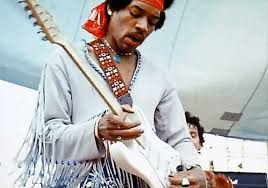
Then Jimi Hendrix walked on stage carrying a white Fender Stratocaster.

What happened next wasn’t just a guitar solo. It was a moment that captured everything happening in America in 1969. The Vietnam War. The protest movements. The Cultural Revolution.
Hendrix played “The Star-Spangled Banner.”
But he didn’t play it straight. He made that guitar scream like bombs falling. He created feedback that sounded like air raid sirens. Furthermore, he used his whammy bar to mimic the whistle of missiles.
It wasn’t just music. It was a statement. And everyone watching knew they were seeing something they’d never forget.
Time magazine later called it “the most electrifying moment of Woodstock.”
The white Stratocaster in his hands became instantly iconic.
The Guitar
The star of that morning was a 1968 Olympic White Fender Stratocaster, serial number 240981.
Hendrix bought it at Manny’s Music in New York City. It had an alder body, a two-piece maple neck, and the classic single-coil pickups for which Fender was famous.
But what made this guitar truly special was how Hendrix used it.
Jimi Hendrix was left-handed. But instead of buying a left-handed guitar, he just took a right-handed Stratocaster and flipped it upside down. Then he restrung it backwards so it would work for a lefty.
This simple flip changed everything about how the guitar sounded.
The reversed string tension: When you flip a guitar, the string lengths change. The high E string, usually the shortest, became the longest. This gave it a fuller, rounder tone. The low E string, usually the longest, became shorter. This made it brighter and snappier.
The reversed pickups: Stratocaster pickups are angled to balance the volume across all six strings. When Hendrix flipped the guitar, those pickups were now reversed. This made his high strings warmer and his low strings clearer.
Many guitarists today believe this reversed setup was essential to Hendrix’s unique sound.
The Olympic White finish wasn’t just about looks, either. Under stage lights, against Hendrix’s colorful clothes, that white guitar created a striking visual contrast. Photographers couldn’t resist it. That’s why almost every famous photo from Woodstock shows that white Stratocaster.
Hendrix nicknamed this guitar “Izabella.”
The Performance
By the time Hendrix took the stage that Monday morning, Woodstock was supposed to be over. The festival had started on Friday. Most bands had played on Saturday and Sunday. The crowd was supposed to leave Sunday night.
But scheduling problems and delays meant Hendrix, the headliner, didn’t perform until Monday morning.
Only about 30,000 to 40,000 people remained. They were tired, hungry, and covered in mud from three days of rain.
Hendrix played for nearly two hours. He performed classics like “Foxy Lady,” “Purple Haze,” and “Hear My Train a Comin’.”
But about halfway through his set, he played “The Star-Spangled Banner.”
Hendrix transformed the national anthem into something nobody had ever heard before.
He used:
Feedback, controlled screaming sounds that mimicked bombs and explosions.
Distortion, heavy fuzz that made the guitar sound aggressive and angry.
Whammy bar, creating dive-bomb sounds like falling missiles.
Volume swells, building tension and release.
The performance lasted about 3.5 minutes. But those minutes became one of the most analyzed, discussed, and celebrated moments in rock history.
Some people thought it was disrespectful to the anthem. Others saw it as the most patriotic thing anyone had done, using art to protest a war that was killing thousands of young Americans.
Hendrix later said he was playing what he felt. “All I did was play it,” he told Dick Cavett.
“I’m an American, so I played it.”
Whatever his intention was, the image of Hendrix with that white Stratocaster, creating those revolutionary sounds, burned itself into the collective memory of a generation.

After Woodstock
The white Stratocaster, “Izabella,” continued to be Hendrix’s main guitar after Woodstock. It was the last guitar he played with the original Jimi Hendrix Experience. It was also the guitar he used in his final concert, held just over a year after Woodstock, on September 18, 1970, and the one he died with.
Hendrix died at age 27, leaving behind a legacy that would influence every rock guitarist who came after him.
After his death, the white Stratocaster passed through several hands. First, it stayed with Hendrix’s father, Al Hendrix, as part of Jimi’s estate.
In the early 1990s, the guitar was auctioned at Sotheby’s. Its authenticity was carefully documented by Hendrix’s former guitar tech and band members, who confirmed it was the actual Woodstock instrument.
It briefly belonged to Italian collector Gabriele Ansaloni, who had one of the world’s largest Hendrix collections.
But in 1998, Microsoft co-founder Paul Allen bought it.
Allen was a serious music fan and a guitar player himself. He recognized the historical importance of this particular Stratocaster. He founded the Museum of Pop Culture (originally called Experience Music Project) in Seattle, and he made this guitar one of the centerpiece exhibits.
Today, you can see it there. The museum has taken extraordinary care to preserve it exactly as Hendrix left it.
You can still see the cigarette burns on the headstock where Hendrix would tuck his cigarettes during performances. The body shows natural wear from countless hours of playing. Every scratch and mark tells a story.
Why This Guitar Matters
Hendrix played many guitars during his short career. He had other white Stratocasters.
He played the famous hand-painted Strat he burned at Monterey Pop Festival in 1967.
He played black Stratocasters.
He even played a Gibson Flying V.
But none of those guitars achieved the legendary status of the Woodstock white Strat.
The moment: Woodstock was already the biggest music festival in history. Hendrix’s performance of “The Star-Spangled Banner” became the defining moment of that festival. The guitar he held became forever linked to that moment.
With its reversed configuration and Hendrix’s technique, created sounds that had never been heard before. It wasn’t just good guitar playing. It was something entirely new.
The performance happened at a turning point in American history. The Vietnam War was dividing the country. Young people were questioning everything. Hendrix’s version of the anthem captured all that complexity in three minutes.
The guitar became a symbol not just of Hendrix’s genius, but of an entire era.
The Legacy
Over 50 years later, that white Stratocaster still matters.
Fender has created multiple tribute models trying to recreate it. The Museum of Pop Culture draws visitors from around the world who want to see it in person.
Guitar players still study Hendrix’s technique, trying to understand how he created those sounds. They debate the importance of the reversed string configuration. They experiment with his effects pedals and amp settings.
But here’s what every serious guitarist eventually learns: You can buy the same guitar.
You can set it up the same way.
You can use the same effects and amps.
But you still won’t sound like Jimi Hendrix.
Because the magic wasn’t just in the gear, it was in his hands, his vision, his creativity, his willingness to push boundaries and try things nobody else would dare.
That Monday morning at Woodstock, as the sun rose over a muddy field, Jimi Hendrix showed the world what was possible. He proved that a guitar could be more than just an instrument.
It could be the voice of a generation.
And that’s what the white Stratocaster became.