
The Early Voice and the Seattle Soil
Chris Cornell grew up in Seattle, finding his footing in a house filled with anxiety and internal noise. He spent long stretches of his youth retreating into music, listening to old records, and learning how to manipulate the drums.
By the early 1980s, that isolation turned into a desire to create something real in the local music scene. He joined a cover band named The Shemps, which featured bassist Hiro Yamamoto. When that group fell apart, Cornell and Yamamoto stayed in contact, eventually bringing in guitarist Kim Anand Thayil.
Thayil had moved west from Illinois alongside Bruce Pavitt, a friend who was starting an independent project that would become Sub Pop Records.
In 1984, Cornell, Thayil, and Yamamoto officially formed a new group. They took their name from an outdoor steel pipe art installation in Seattle called “A Sound Garden,” which caught the wind and made low, haunting noises.
At first, Cornell sat behind the drum kit while singing lead. The physical demand of hitting cymbals while delivering a four-octave vocal range proved too restrictive, so the band hired drummer Scott Sundquist in 1985 to free Cornell up at the front of the stage.
This lineup entered the studio to record three tracks for a 1986 compilation album called Deep Six, released by C/Z Records. The compilation featured local peers like Green River, Malfunkshun, and The Melvins, establishing a sluggish, heavy alternative rock style before anyone outside the Pacific Northwest knew the word grunge.
The Underground Shift and the Major Label Risk
By late 1986, Sundquist left the band to focus on his family. Soundgarden found its permanent replacement in Matt Cameron, a precise drummer who had been playing with Skin Yard.
Cameron brought a mathematical stability to the rhythm section, capable of handling odd timings without losing the physical weight the band required.
Jonathan Poneman, a local radio disc jockey, saw the band play live and offered to put up $20,000 to fund their first single, partnering with Bruce Pavitt to transform Sub Pop into a functioning record label.
Sub Pop released the single “Hunted Down” in 1987, followed by the Screaming Life extended play later that year and the Fopp extended play in 1988.
The underground scene noticed Cornell immediately. His vocals could shift from a low, gravelly baritone to a piercing scream that sounded like heavy metal but carried a raw, unpolished punk attitude.
The band signed with SST Records to release their full-length debut, Ultramega OK, in late 1988. The record earned underground praise, but the band grew frustrated with the muddy production quality.
Driven by Cornell’s creative ambition, Soundgarden made a choice that fractured their relationship with the strict independent community: they signed with A&M Records, becoming the first Seattle grunge band to jump to a major label. They recorded Louder Than Love, released in September 1989.
The album featured tracks like “Loud Love” and “Hands All Over,” showcasing Thayil’s heavy, sludgy guitar textures and unusual time signatures, such as the 9/4 pattern on “Get on the Snake.”
The commercial transition proved difficult for Yamamoto, who felt disconnected from the major-label ecosystem. He left the band to return to college, leaving Soundgarden without a permanent bassist just as they began their first major tour.
The Classic Lineup and the Rise of Badmotorfinger
After briefly using Jason Everman on bass, the band found Ben Shepherd in 1990. Shepherd brought a visual intensity and an erratic, low-end bass style that pushed the band away from standard heavy metal structures.
He also contributed heavily as a songwriter, shifting the internal dynamic so Cornell did not have to carry the musical direction alone.
This classic four-piece lineup entered the studio with producer Terry Date to record Badmotorfinger, released on October 8, 1991. The album hit the public just as the Seattle music explosion was becoming a global phenomenon, arriving just weeks after Nirvana released Nevermind.

The music on Badmotorfinger was dense and aggressive. On “Rusty Cage,” Cornell wrote a guitar riff that used an unusual bottom-string tuning, ending the song in a slow, mechanical groove that sounded like turning iron gears.
The single “Outshined” became a staple on rock radio, driven by a heavy 7/4 rhythm and Cornell’s lyrics about deep emotional swings.
The track “Jesus Christ Pose” featured a chaotic, high-speed wall of sound, with Cameron playing a frantic drum pattern while Thayil made his guitar mimic the sound of helicopter blades with a wah-wah pedal.
MTV pulled the music video from rotation due to controversy over its religious imagery, but the track solidified the band’s reputation as an uncompromising live act. The album climbed to number 39 on the Billboard 200 chart, earning double-platinum status.
The Zenith of Superunknown
In 1993, Soundgarden began working with producer Michael Beinhorn to create their fourth album, Superunknown. Released on March 8, 1994, the record debuted at number one on the Billboard 200 and became a multi-platinum success.
The recording sessions were long and exhausting, with Cornell focusing on his isolated mental state to write lyrics that dealt with depression, loss, and substance problems.
The sound of Superunknown was different from their earlier work; it was broader, darker, and more melodic. The lead single, “Spoonman,” featured an unusual 7/4 time signature and actual percussion tracks played with metal spoons by a local street performer named Artis the Spoonman.
The biggest track on the record, “Black Hole Sun,” became a massive international hit. Built around a swirling, psychedelic guitar line that Thayil played through a Leslie speaker cabinet, the song combined a melancholic melody with an unsettling arrangement.
Cornell’s vocals on the track stayed low during the verses before rising into a layered scream during the heavy choruses.
Other tracks like “Fell on Black Days” and “The Day I Tried to Live” used odd timings, such as 6/4 and 15/8, but delivered them in a way that felt natural to mainstream listeners.
Audiences responded to the human vulnerability in Cornell’s voice, and the band found themselves playing massive outdoor arenas and headlining international festivals.
Fractures and the Final Act
By 1996, the constant pressure of touring and the desire for different musical directions began to damage the band’s internal relationships. They chose to self-produce their fifth album, Down on the Upside, which came out in May 1996.
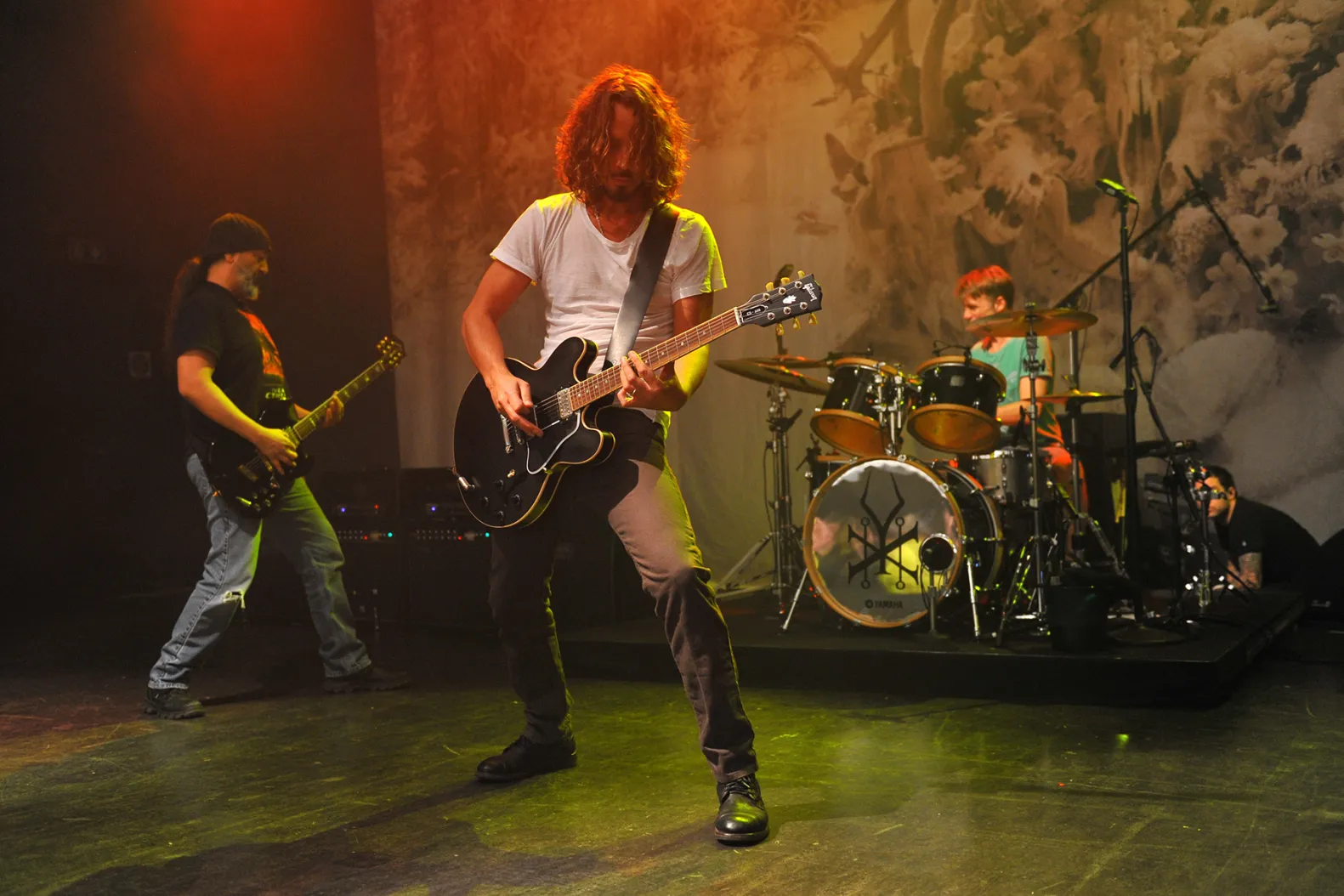
Cornell wanted to move away from the heavy, downtuned guitar riffs that had defined their early career, favoring acoustic arrangements and cleaner vocals. This caused direct disagreements with Thayil, who wanted to keep the heavy rock elements intact.
Songs like “Pretty Noose” and “Burden in My Hand” showed this transition, featuring intricate alternative tunings but relying more on traditional pop-rock structures. The track “Blow Up the Outside World” reflected Cornell’s growing exhaustion and need for quiet.
During the subsequent world tour, the internal communication broke down completely. On February 9, 1997, the band played a chaotic, frustrated final show in Honolulu, Hawaii, where Shepherd threw his bass guitar into the air in frustration. Two months later, in April 1997, Soundgarden announced they were breaking up.
For over a decade, the members went their separate ways. Cornell released solo albums and formed Audioslave with former members of Rage Against the Machine, while Matt Cameron joined Pearl Jam as their permanent drummer.

In 2010, Cornell used his social media channels to announce that the school was back in session. The classic lineup reunited, releasing a live collection called Live on I5 and recording a new studio album titled King Animal in 2012.
The new material, such as the single “Been Away Too Long,” retained its signature odd meters but carried a mature, steady rock energy. The band spent the next several years touring international theaters and arenas, showing a renewed sense of pride in their catalog.
On May 17, 2017, Soundgarden played a sold-out show at the Fox Theatre in Detroit, Michigan. The concert ended with a performance of “Slaves & Bulldozers,” which Cornell regularly interlaced with lyrics from Led Zeppelin’s “In My Time of Dying.”
Hours after the performance concluded, Cornell returned to his room at the MGM Grand Detroit hotel. He was found unresponsive in his bathroom later that night and was pronounced dead at the age of 52. The Wayne County Medical Examiner ruled his death a suicide by hanging.
The loss brought an immediate, permanent end to Soundgarden’s journey as an active band. The remaining members chose not to replace their frontman, recognizing that the group’s sound was inextricably tied to Cornell’s human perspective and vocal capabilities.
What remained was a catalog of music that proved heavy guitar rock could hold genuine artistic depth, leaving a permanent mark on the history of modern rock music.