
From Dublin Clubs to a Band Finding Its Voice
Thin Lizzy came together in Dublin in 1969, built around Phil Lynott and drummer Brian Downey. They already knew each other from earlier bands, so there was a sense of familiarity from the start. What they did not have yet was a clear direction.
The early years moved through different sounds. Some songs leaned into blues, others carried a folk feel, and a few pushed toward harder rock. The records came out, the band played live, and they kept working, but nothing settled long enough to define them.
Lynott stood at the center even then. He handled vocals, bass, and most of the writing. His songs came from real places, people he had seen, and situations he understood, which gave the band a voice before it had a fixed sound. That voice carried them through the early years when success stayed out of reach.
“Whiskey in the Jar,” released in 1972, changed their position. The song picked up radio play and reached a wider audience. It gave the band visibility across the UK and beyond, but it also left them in an unusual position. They had attention, but the sound people recognized them for did not fully represent where they were heading.
They kept moving, still searching for something that held together.

The Moment the Sound Came Together
The shift came through the lineup.
When Scott Gorham and Brian Robertson joined, the band found something that worked. Instead of one guitarist leading and the other supporting, both worked side by side. The guitar lines ran together, sometimes matching, sometimes separating, but always moving with intent.
That approach gave the band a sound people could recognize straight away.
At the same time, Lynott’s writing moved into a clearer space. The songs focused on people, places, and situations that felt real. They were grounded, direct, and built to connect without overstating anything.
By the time they recorded Jailbreak in 1976, the band had found its identity.
“The Boys Are Back in Town” reached a wide audience. It worked on the radio, but more importantly, it worked live. It gave the band a song that people carried with them.
“Jailbreak” and “Cowboy Song” reinforced that direction. The sound was clear, twin guitars, strong rhythm, and songs built to move forward without excess.
The Years Where Everything Lined Up
From 1975 through 1979, Thin Lizzy moved with momentum.
Albums like Jailbreak, Johnny the Fox, Bad Reputation, and Black Rose: A Rock Legend kept them active and visible. The band toured heavily, building a strong reputation on stage.
Live shows became a key part of their identity. The twin guitars worked in sync, Downey kept the rhythm steady, and Lynott carried the front with control. There was no extra weight to their play. Each part had a role.
Live and Dangerous captured that period. It showed a band that knew how to deliver its songs to an audience without losing its shape.
During these years, the band reached its strongest point.
At the same time, movement inside the band never stopped.
Gary Moore moved in and out of the band, and each return changed the guitar sound straight away. His playing came in faster, more aggressive, and more precise, and every time he left, the band had to reset around a different approach.

The scale grew as well, larger tours, more travel, more expectations. The band kept going, but the pace carried its own cost.
The Weight of the Early 1980s
By the early 1980s, Thin Lizzy were still recording and touring, but the balance that held the late 1970s run together started to loosen.
Lineup changes became more frequent. Different guitarists stepped in, each bringing something different, but the connection that once held steady began to drift.
Lynott remained at the center, but his situation changed.
Drug use started to affect how the band operated. It showed in the way recording sessions moved, in how tours were handled, and in the overall direction of the group.
Albums like Chinatown and Renegade kept the band active, but the consistency from earlier years was harder to maintain. The drive to keep going remained, but the control behind it was slipping.
They pushed forward into Thunder and Lightning in 1983. The album had a tighter, sharper edge and a heavier sound than its predecessors. It felt like a final push rather than the start of a new phase.
The band went on tour that same year.
In 1980, while Thin Lizzy was still active, Phil Lynott stepped out with his solo album Solo in Soho, which reached the UK Top 30 and brought singles like “Dear Miss Lonelyhearts” and “King’s Call,” the latter written as a tribute to Elvis Presley and featuring Mark Knopfler on guitar.
His follow-up, The Philip Lynott Album in 1982, did not land the same way, though “Yellow Pearl” reached No. 14 in the UK and became linked to Top of the Pops.
After Thin Lizzy’s final run in 1983, Lynott recorded a rock and roll single with Roy Wood, Chas Hodges, and John Coghlan, and continued working with Gary Moore on tracks like “Out in the Fields.” In 1984, he formed Grand Slam and took it into small venues, but the band struggled to move forward and broke up within the year.
Through this period, his addiction worsened and began to take control of both his work and personal life, leading to his collapse at his home in Kew on 25 December 1985. That moment closed the original chapter of Thin Lizzy.
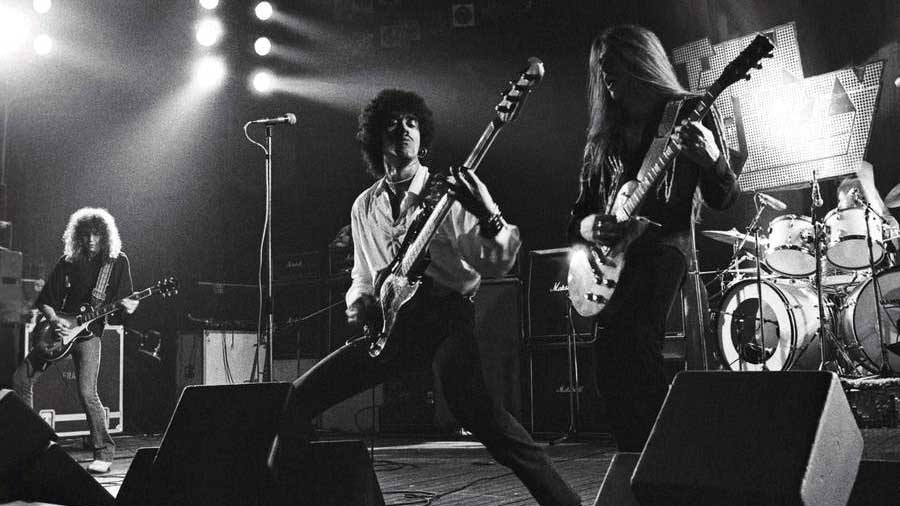
Thin Lizzy left behind more than a set of records.
The twin-guitar approach became part of how hard rock and metal bands built their sound. It carried forward into bands across the UK and beyond, shaping how guitars worked together in that space.
Lynott’s writing stood out for a different reason. His songs carried people and situations that felt real. They held Weight without relying on a scale or volume.
The band moved through different forms over the years, but the sound it built during its strongest period remained.
Thin Lizzy built their sound through years of change, carried it through a strong run, and left behind a body of work that continued to move long after the band stopped.