
A band that lasted barely two years, yet forced rock music, fashion, and culture into a different direction
The Sex Pistols built their reputation in a short, intense burst, leaving behind a small body of work that carried far beyond its size.
Their entire existence as an active band lasted a little over two years. Yet, within that time, they reshaped the direction of British rock and pushed punk from a small underground movement into a national confrontation.
Their story unfolded in a short, chaotic run instead of a steady climb. It moved through formation, explosion, conflict, and collapse in a very short span, with each phase tied closely to the people involved and the environment around them.
Before the Name Meant Anything
The band did not begin as the Sex Pistols.
In the early 1970s, guitarist Steve Jones and drummer Paul Cook were part of a loose group called the Strand, later known as the Swankers.
They were still finding their sound, playing rough, direct music without a fixed direction. They were part of the King’s Road scene in London, spending time around shops, music circles, and a growing underground culture that mixed fashion, art, and music.
One of the central places in that environment was the boutique run by Vivienne Westwood and Malcolm McLaren. The shop was not just a retail space. It served as a meeting point for people already moving against mainstream culture.
McLaren saw potential in Jones and Cook, not just as musicians, but as part of a larger idea. He stepped in as manager and began shaping the band as a project that would challenge existing norms, both musically and visually.
The lineup didn’t hold for long; Wally Nightingale was replaced, Glen Matlock came in on bass, and in 1975, Malcolm McLaren brought in John Lydon to take the front.
Lydon came from a rough background, with no formal training and no attempt to smooth his voice. His voice was raw, uneven, and confrontational, but that was exactly what fit the direction the band was moving toward.
With that, the band’s core identity began to take shape.
Building the Image and the Reaction
From the start, the Sex Pistols pushed beyond music; everything around them was designed to provoke and challenge what rock had turned into.
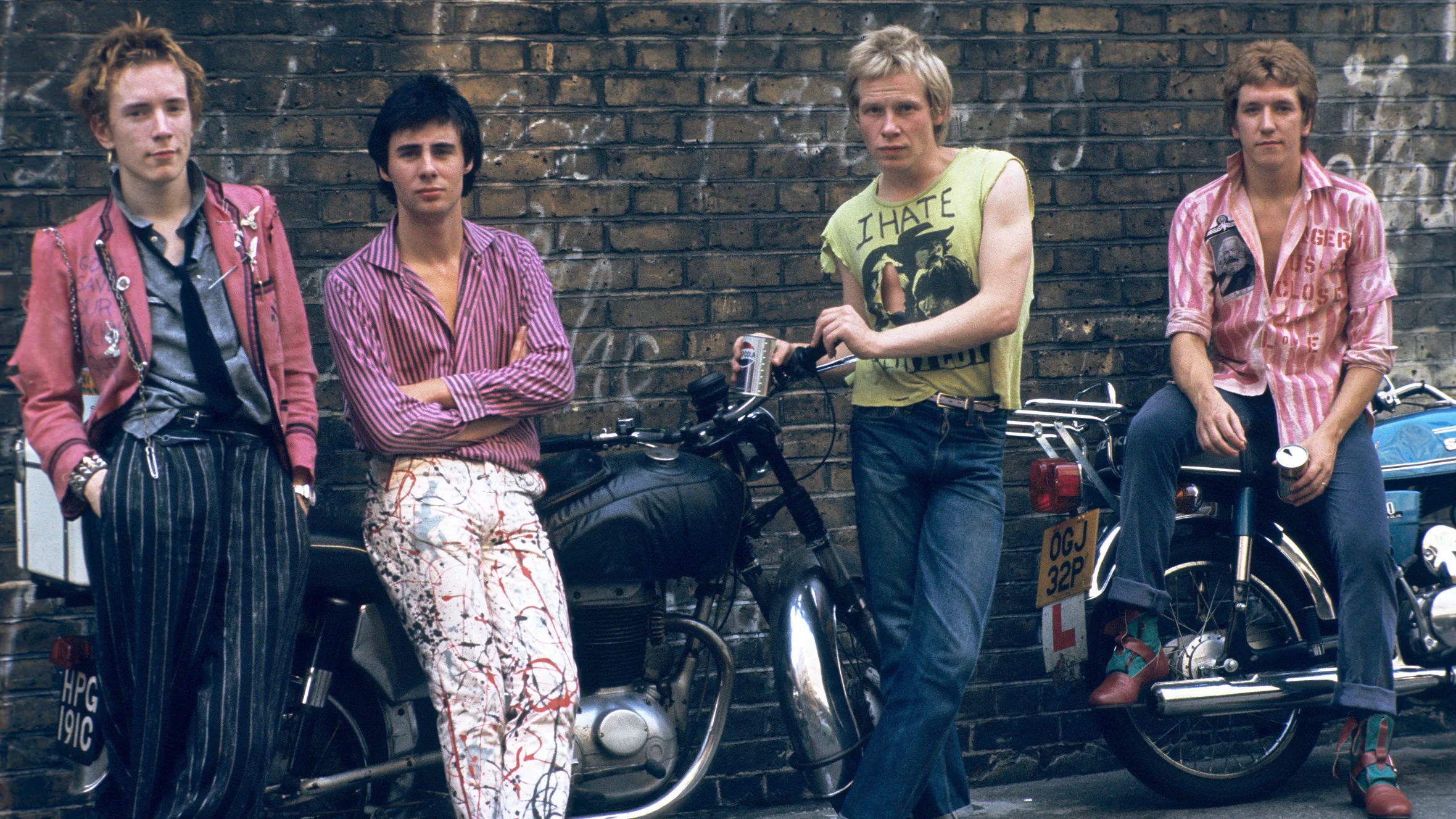
Their early shows in 1975 and 1976 were chaotic; the energy had no boundaries, and the band let it run. The sound was loud, direct, and stripped back, built around simple guitar work and a rhythm section that kept everything moving forward without decoration.
Their rise into public attention came through both the music and the way they carried themselves.
Television appearances, interviews, and public behavior created immediate backlash. The now-famous 1976 television incident on the Bill Grundy show turned them into the subject of a national controversy overnight.
The language, the attitude, and the refusal to conform to expected behavior made them visible far beyond the small venues where they had been playing.
That visibility came with consequences, but it also spread the punk identity.
The Lineup That Defined Them
The most recognized version of the band included:
John Lydon (Johnny Rotten) on vocals
Steve Jones on guitar
Paul Cook on drums
Glen Matlock on bass
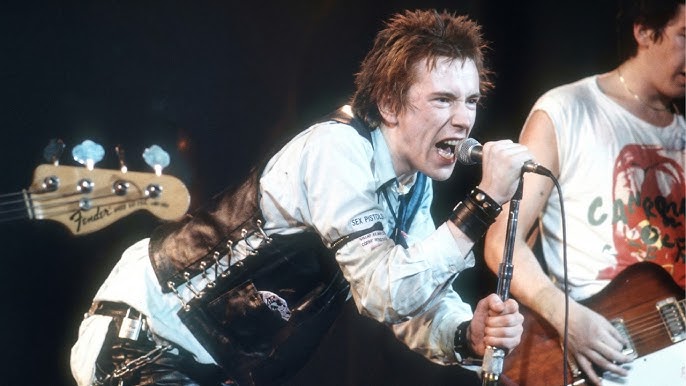
Matlock played a key role in the early phase, contributing to the songwriting and bringing a more melodic sense to the material. However, by 1977, he was replaced by Sid Vicious.
Vicious was not brought in for technical ability. His playing was limited, and much of the bass work on recordings still came from Jones. His role was visual and symbolic. He represented the darker side of the movement: instability, self-destruction, and the rejection of any form of refinement.
His presence changed how the band was perceived, pushing them further into controversy and myth.
The Music That Defined Punk
Despite the attention around them, the band’s recorded output was limited.
Between 1976 and 1977, they released four major singles.
“Anarchy in the U.K.” introduced them with a direct statement. The song carried aggression without complexity, built around a riff that did not try to expand beyond its core idea.
“God Save the Queen” followed, released during the Queen’s Silver Jubilee in 1977. The timing was deliberate. The song became more than a track. It became a national issue, banned in several places, yet widely discussed and consumed.
“Pretty Vacant” and “Holidays in the Sun” expanded their reach, showing that the band could produce songs that carried the same attitude while working within a format that could reach a wider audience.
All of this led to their only studio album.
Never Mind the Bollocks, Here’s the Sex Pistols, released in 1977, brought all of these elements together. The album did not attempt to stretch beyond its identity. It stayed direct, loud, and confrontational.
Tracks like “Bodies” pushed further into uncomfortable territory, while others reinforced the band’s position against authority and control.
The playing was simple, but that simplicity became part of its influence. It showed that technical ability was not the central requirement. What mattered was intent, delivery, and the willingness to stand behind what was being said.
The Shows and the Build-Up to Collapse
Live performances were a key part of how the band spread.
Their shows were unpredictable, loud, and often unstable. They energized audiences who had not seen anything like it before, but they also created tension, both with venues and within the band itself.
By 1977, the band had moved beyond the underground, but the pressure increased at the same pace.
Legal issues, media backlash, and constant scrutiny made it difficult to operate as a stable unit. Contracts fell apart. Shows were canceled. The environment around them became harder to manage.
1978: The Breaking Point
The United States tour in January 1978 brought everything to the surface.
The venues were poorly matched to the band. The crowds were often hostile. Internal tensions had already been building, and the tour pushed them further.
Sid Vicious’s heroin addiction had worsened, making performances inconsistent and adding strain within the group. At the same time, John Lydon had grown increasingly frustrated with Malcolm McLaren’s direction, which he saw as more focused on spectacle than on the band itself.
The final show in San Francisco captured that collapse.
At the end of the performance, Lydon addressed the crowd with the line, “Ever get the feeling you’ve been cheated?” It was not just a comment on the show. It reflected how he saw the entire situation.
Shortly after, he left the band.
That ended the original Sex Pistols.
Aftermath and Collapse
Without Lydon, the band continued briefly under McLaren’s direction, but the core was gone.
Sid Vicious’s condition continued to deteriorate. His relationship with Nancy Spungen, legal troubles, and addiction pushed him further into instability. In 1979, he died from a heroin overdose.
By that point, the band existed more as an idea than an active group.
What They Left Behind
The Sex Pistols left behind one album and a small number of singles, but their impact extended far beyond that output.
They helped define the British punk movement, not by refining it, but by pushing it into public view with force. Bands like The Clash and The Damned followed, building on what the Pistols had opened.
Their influence also reached beyond the UK. Across the United States and Europe, bands began forming with a similar approach, direct sound, simple construction, and a refusal to follow established paths.
The effect was not limited to music.
Fashion shifted alongside it. The work of Vivienne Westwood, combined with the band’s presentation, created a visual identity that carried into wider culture. Torn clothing, safety pins, and a deliberate rejection of conventional style became part of the punk image.
More importantly, they changed how rock could operate.
They showed that a band did not need years of development, technical precision, or industry approval to create impact. A short run, if carried with enough force, could alter the direction of the entire genre.
The reach of the Sex Pistols went far beyond their own recordings, and many musicians across different genres traced their starting point back to that moment.
Artists from bands like Nirvana, Green Day, Oasis, and Guns N’ Roses have all acknowledged the effect the band had on their approach to music, not through technical influence, but through the idea that a band could start with very little and still reach a wide audience.
For many, the impact came as much from the attitude as from the sound, the sense that music did not need approval or refinement to exist. At the same time, not everyone viewed them the same way.
Members of the Ramones felt the band had built on an existing foundation, while figures from the earlier rock world dismissed them as a constructed act rather than a serious band.
Even within punk, there were differences, with some seeing their approach as too focused on image rather than direction. Despite that divide, the effect remained; the band opened a path that others followed, whether in agreement or in reaction.
The Sex Pistols did not last long, but they forced rock to confront itself, and once that happened, there was no way for it to return to what it had been before.